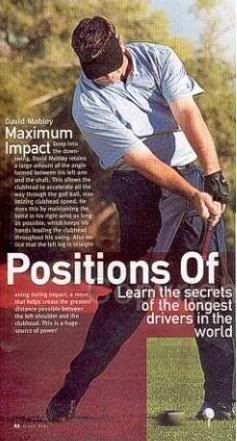
Fulcrum at Left Wrist


This obviously shortens the Swing Radius considerably because it now only extends from the Clubhead to the Left Wrist rather than to the Left Shoulder. It moves Low Point forward -- rather than being opposite the Left Shoulder, it is now opposite the Left Wrist.

But surely a Long Drive Champion such as David Molbey wouldn't be using an inferior procedure like this. He has one of the slowest clubhead speeds in the business, yet he is one of the best. Could this be the reason why?

How can TGM explain this?

Lets say he does this because he wants to hit down on the ball. But what's the advantage of this procedure compared with the standard one where you just place the ball behind the Left Shoulder without changing Low Point location?

I have more comments later. I'd like to hear what you guys have to say.
Originally Posted by tongzilla
This obviously shortens the Swing Radius considerably because it now only extends from the Clubhead to the Left Wrist rather than to the Left Shoulder. It moves Low Point forward -- rather than being opposite the Left Shoulder, it is now opposite the Left Wrist.

But surely a Long Drive Champion such as David Molbey wouldn't be using an inferior procedure like this. He has one of the slowest clubhead speeds in the business, yet he is one of the best. Could this be the reason why?

How can TGM explain this?

Lets say he does this because he wants to hit down on the ball. But what's the advantage of this procedure compared with the standard one where you just place the ball behind the Left Shoulder without changing Low Point location?

I have more comments later. I'd like to hear what you guys have to say.
I am not so sure that Mr. Kelley will actually classify this as a shortening of a swing radius.

Per 7-17, halting the backstroke with the feet and letting the same tension pull the Downstroke through Impact is "swinging from the feet" and gives the Stroke maximum Swing Radius.

The difference between this look that Mobley exhibits and a bent left wrist at impact is that the former does not result in disruption of clubhead orbit and throwaway, while the latter does.

That Mobley is Long Drive Champion despite a "shortened swing radius" proves that there is more to long drives than just pure clubhead speed.

Per 2-M-1, power is mathematically expressed as 1/2 Mass x Velocity Squared.

Per 2-M-2,
Mass is varied by Acceleration Rate and Swing Radius.
Clubhead speed is varied by Acceleration Time and Release Interval.

Other factors that need to be considered is centeredness of impact, wind, equipment etc...
1. 2-K Compare the Primary Lever Assembly (6-A-2) with the common flail. While the “swingle” is seeking its “in-line” (full extension ) relation with the “handle” (catching up) there is “Centrifugal Acceleration.” When it becomes “in-line” (caught up) this settles into “Centrifugal (Angular) Momentum” (Full Extension). If it passes its “in-line” relation, it again seeks its “in-line” relation (backs up) and “Centrifugal Deceleration” sets in with a huge power loss. These three phases demonstrate what is termed herein “The Law of the Flail” - the Swingers primary concern.

2. 2-P . So as the Clubhead moves from minimum to maximum radius, its Surface Speed (6-N-0) in miles per hour (MPH) increases geometrically. However, the RATE at which the Clubhead radius increases is an additional velocity factor - that is, its “Overtaking Rate” (6-F). Which is dictated by Hand Speed, Trigger Delay (7-20, 7-23) and Travel and which continues until the In-Line (6-B-0) FULL EXTENSION of the Lever Assembly (6-A) is achieved. So for maximum Power at any Clubhead Speed, the Ball must be struck before Full Extension per 2-N-1. Full Extension (Angular Momentum 2-K) can occur at any time or exist all the time during a Stroke per Pattern, regardless of Impact Point or Low Point (2-N). Impact during Full Extension produces a “soft” Impact and is a very useful simplification. See 2-K and 2-L#2.
Originally Posted by 12 piece bucket 1. 2-K Compare the Primary Lever Assembly (6-A-2) with the common flail. While the “swingle” is seeking its “in-line” (full extension ) relation with the “handle” (catching up) there is “Centrifugal Acceleration.” When it becomes “in-line” (caught up) this settles into “Centrifugal (Angular) Momentum” (Full Extension). If it passes its “in-line” relation, it again seeks its “in-line” relation (backs up) and “Centrifugal Deceleration” sets in with a huge power loss. These three phases demonstrate what is termed herein “The Law of the Flail” - the Swingers primary concern.

2. 2-P . So as the Clubhead moves from minimum to maximum radius, its Surface Speed (6-N-0) in miles per hour (MPH) increases geometrically. However, the RATE at which the Clubhead radius increases is an additional velocity factor - that is, its “Overtaking Rate” (6-F). Which is dictated by Hand Speed, Trigger Delay (7-20, 7-23) and Travel and which continues until the In-Line (6-B-0) FULL EXTENSION of the Lever Assembly (6-A) is achieved. So for maximum Power at any Clubhead Speed, the Ball must be struck before Full Extension per 2-N-1. Full Extension (Angular Momentum 2-K) can occur at any time or exist all the time during a Stroke per Pattern, regardless of Impact Point or Low Point (2-N). Impact during Full Extension produces a “soft” Impact and is a very useful simplification. See 2-K and 2-L#2.
In other words, the Clubhead should be accelerating all the way until the Clubhshaft reaches its in-line condition with the Left Arm. Which should mean that maximum power is achieved before Full Extension -- but how far? Common sense says that it probably wouldn't be five feet before Full Extension is reached. It should be just slightly before.
Originally Posted by tongzilla

This obviously shortens the Swing Radius considerably because it now only extends from the Clubhead to the Left Wrist rather than to the Left Shoulder. It moves Low Point forward -- rather than being opposite the Left Shoulder, it is now opposite the Left Wrist.

But surely a Long Drive Champion such as David Molbey wouldn't be using an inferior procedure like this. He has one of the slowest clubhead speeds in the business, yet he is one of the best. Could this be the reason why?

How can TGM explain this?

Lets say he does this because he wants to hit down on the ball. But what's the advantage of this procedure compared with the standard one where you just place the ball behind the Left Shoulder without changing Low Point location?

I have more comments later. I'd like to hear what you guys have to say.
Many people jump to the conclusion that the Left Wrist is Arched when they see this picture. But is it really?
What could be happening is this. David has his Aiming Point very far forward. This naturally delays the Release to the extent that the Clubhshaft cannot reach its in-line condition with the Left Arm before the Left Arm is vertical to the ground. This explains how he can have the ball after the Left Shoulder and at the same time not have the Clubhead ascending during Impact. All without an Arched Left Wrist. So here's something to think about for those who say that Low Point is always opposite the Left Shoulder when you have a Flat Left Wrist.

It may look unorthodox, but I think placing the ball well forward is a great way to learn how to hit down. Also teaches you to how to control the direction of your Thrust from the Top. Do this for a while, then place the ball back to a more 'normal' location, you will suddenly find it very easy to hit down.
Nice Post Tong...How would move this Fulcrum back to the Shoulder?
Originally Posted by tongzilla Many people jump to the conclusion that the Left Wrist is Arched when they see this picture. But is it really?
What could be happening is this. David has his Aiming Point very far forward. This naturally delays the Release to the extent that the Clubhshaft cannot reach its in-line condition with the Left Arm before the Left Arm is vertical to the ground. This explains how he can have the ball after the Left Shoulder and at the same time not have the Clubhead ascending during Impact. All without an Arched Left Wrist. So here's something to think about for those who say that Low Point is always opposite the Left Shoulder when you have a Flat Left Wrist.

It may look unorthodox, but I think placing the ball well forward is a great way to learn how to hit down. Also teaches you to how to control the direction of your Thrust from the Top. Do this for a while, then place the ball back to a more 'normal' location, you will suddenly find it very easy to hit down.
I think the wrist looks LEVEL and TURNED moving to FULLY-UNCOCKED (FULL LEVER EXTENSION) and Rolled. Do you have the next pic in a sequence? How about these . . . Let's get learnt from these.


More . . .


How about the Wedges on Duval. How could he miss it even with the Turned Left Hand. I would like to see his move now. With all the press he's gettin' on his improved play looks like we could find a recent sequence. He's back to being fat now. Which you gotta like. Winner!!! Winnner!!! Chicken Dinner!!!!!
What a great picture of Trevino- I got to buy that one.
Originally Posted by tongzilla Many people jump to the conclusion that the Left Wrist is Arched when they see this picture. But is it really?
What could be happening is this. David has his Aiming Point very far forward. This naturally delays the Release to the extent that the Clubhshaft cannot reach its in-line condition with the Left Arm before the Left Arm is vertical to the ground. This explains how he can have the ball after the Left Shoulder and at the same time not have the Clubhead ascending during Impact. All without an Arched Left Wrist. So here's something to think about for those who say that Low Point is always opposite the Left Shoulder when you have a Flat Left Wrist.

It may look unorthodox, but I think placing the ball well forward is a great way to learn how to hit down. Also teaches you to how to control the direction of your Thrust from the Top. Do this for a while, then place the ball back to a more 'normal' location, you will suddenly find it very easy to hit down.
I love your analysis Leo, and I must admit that I am guilty of stereotyping this "look" to be the product of an arched wrist.

As such, I have altered my original reply to your post accordingly.
Originally Posted by tongzilla

This obviously shortens the Swing Radius considerably because it now only extends from the Clubhead to the Left Wrist rather than to the Left Shoulder. It moves Low Point forward -- rather than being opposite the Left Shoulder, it is now opposite the Left Wrist.

But surely a Long Drive Champion such as David Molbey wouldn't be using an inferior procedure like this. He has one of the slowest clubhead speeds in the business, yet he is one of the best. Could this be the reason why?

How can TGM explain this?

Lets say he does this because he wants to hit down on the ball. But what's the advantage of this procedure compared with the standard one where you just place the ball behind the Left Shoulder without changing Low Point location?

I have more comments later. I'd like to hear what you guys have to say.
Tong,
This is certainly one place where TGM is the only place to be, to have this explained!

Slower clubhead speed? KE=1/2M x V squared Especially with a guy the size and strength of this guy, and the athletic motion (lag) that he makes.

Lowpoint? His clubhead is at lowpoint, opposite the left shoulder- and now he's going to be hitting slightly upward on the ball. If the clubhead goes lower- looks like he'll pop it up to me.

Angular Acceleration? Until he get's to both arms straight- he's going to have Angular Acceleration.

Most the time someone's hitting up on the ball- they have allowed the left wrist to bend- but not in this situation.


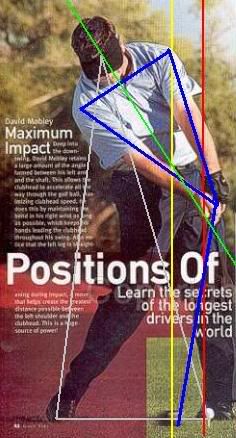
Yellow Line:
where Low Point would be if it was opposite Left Shoulder.
Red Line: Impact Line
Blue Lines: Power Package and Primary Lever Assembly (Left Arm and Club)
Grey Triangle: Base of neck in relation to feet.
Green Line: Axis Tilt

The only way that Clubhead will be going up from there is if the Clubshaft doesn't get any more in line with the Left Arm. Which is extremely unlikely.
Hi tongzilla,

My eyes are very uneducated but aren't we assuming here that his head remains in the same place. It looks to me like his head is slightly behind centre, might his head be moving up and backwards to allow him room to hit the ball?
Originally Posted by danny_shank Hi tongzilla,

My eyes are very uneducated but aren't we assuming here that his head remains in the same place. It looks to me like his head is slightly behind centre, might his head be moving up and backwards to allow him room to hit the ball?
Whether the Head remains in the same place really isn't relevant in this discussion, since we are not talking about the Pivot Center Tripod, etc. I've drawn the 'Tripod' for illustrative purposes only, not to substantiate my argument.
Originally Posted by tongzilla

Yellow Line:
where Low Point would be if it was opposite Left Shoulder.
Red Line: Impact Line
Blue Lines: Power Package and Primary Lever Assembly (Left Arm and Club)
Grey Triangle: Base of neck in relation to feet.
Green Line: Axis Tilt

The only way that Clubhead will be going up from there is if the Clubshaft doesn't get any more in line with the Left Arm. Which is extremely unlikely.
Tong,
Great work with the lines! Really helps isolate some of the conversation or at least take a little of the "seems as if" out of the equation. (I need to get up to speed on some of those computer programs!) In fact, I think "your" cover with the lines, looks better than the original magazine cover!

With everything- there is always room for interpretation, understanding, etc. So I'm not pushing all in on this one, but I'm still sticking with my original analysis. Specifically in regards to the upswing comment A) looks to me like if that clubhead goes down much more he is not going to hit it on the face properly and B) From where he is - I don't see why he couldn't retain whatever angles he has remaining (#1,#2, #3, #4 accumulators)until impact- afterall, at that speed and time between where the clubhead is now and impact - not much is going to happen- whatever down or up the clubhead makes is going to be small. I just think that due to everything else that I'm seeing and specifically if the clubhead could move up or down from that pre-impact location- that it would or would need to move up.

It would be great to get a photo at impact of this guy and then draw your lines showing any movement change between this frame and the impact frame. Even with lines it might be so small that you couldn't isolate the change visually.

Interesting topic though- and to isolate what I thought was at least one of the original questions-
A) What's happening here? I guess we're still figuring that out.
B) Can TGM explain it. This is where I think you and I had/have a different impression regarding what was happening. But regardless, in this context whatever is happening - I feel that TGM could definitely still explain it- after all you've put the question right in the TGM arena - regarding low point, angular motion, etc. I'm one who has never said that TGM had ALL the answers- but on this one whatever the answer is- I think TGM would have it.

With all of that said, I know that I'm just making an educated or maybe an uneducated guess- I'm not sure we'll really be able to answer the clubhead up or down issue, in regards to his swing and where it's moving from here to impact- let's see what floats to the top - as the posting continues.

At the risk of sounding obnoxiously repetitive, I will try to clarify a few points. If you tried to swivel my blue line representing the Clubshaft so that it now touches the Ball (Impact), the Clubshaft will still clearly be leaning forwards. Lets call this scenario #1.

Now, one may argue that the Clubshaft will not move like that because the Hands are moving forwards. So lets take this perspective to the extreme -- the Hands from this position shown in the photo move forwards, but all the relevant angles remain constant. Lets call this scenario #2.

Is the Clubhead going up or down? The answer now depends on whether the Hands are going up or down. We can't say for definite, but I'm pretty sure than Hands won't be going down any further from that point. Hence the Clubhead will be ascending during Impact.

Assuming the Left Wrist is Level in the picture (a very plausible assumption), it will be Uncocking from this frame to Follow Through (2-P). That certainly makes scenario #2 a less likely candidate, i.e. unlikely the Clubhead will be ascending during Impact.

Some more information on scenario #1. I said that the blue line (Clubshaft) swivels to Impact. But how? So far, I have only mentioned the Left Wrist Unocking more thereby lengthening the Primary Lever Assembly (a perpendicular motion, but since the Hands are Turned slightly, it will cause the Clubhead to move forward as well as downward).
However, there is also the effect of the Left Wrist Rolling, which will cause the Clubshaft to appear more in-line with the Left Arm from the front view without any Unocking of the Left Wrist. Since Molbey is a Swinger who needs to strike the ball with maximum compression, it is very likely that Horizontal Hinging is being used. And this will clearly accentuate the Rolling effect described. Like Homer said, there must be a definite Hinge Action for every shot, and anyone who wants to argue that there will not be any additional Roll between this frame shown and Separation will need to give a very strong and well thought out reason (e.g. everything is moving so quickly and there is very little time in between, is not a good enough reason).
Originally Posted by Mike O Tong,
Great work with the lines! Really helps isolate some of the conversation or at least take a little of the "seems as if" out of the equation. (I need to get up to speed on some of those computer programs!) In fact, I think "your" cover with the lines, looks better than the original magazine cover!
Thanks Mike . I only used Paint which has been a standard with Windows for god knows how long. None of this fancy Photoshop business. But apparently one can be much more precise with Photoshop. Anyway, this should be suffcient for now.
Originally Posted by Mike O Tong,
This is certainly one place where TGM is the only place to be, to have this explained!

Slower clubhead speed? KE=1/2M x V squared Especially with a guy the size and strength of this guy, and the athletic motion (lag) that he makes.

Lowpoint? His clubhead is at lowpoint, opposite the left shoulder- and now he's going to be hitting slightly upward on the ball. If the clubhead goes lower- looks like he'll pop it up to me.

Angular Acceleration? Until he get's to both arms straight- he's going to have Angular Acceleration.

Most the time someone's hitting up on the ball- they have allowed the left wrist to bend- but not in this situation.
Don't it look like the man himself (Homer Kelley) in Mike O's avatar is pretty much in the same Impact/Fix position as this dude?

Or am I missing something? Ok don't answer that . . .


Originally Posted by 12 piece bucket Don't it look like the man himself (Homer Kelley) in Mike O's avatar is pretty much in the same Impact/Fix position as this dude?

Or am I missing something? Ok don't answer that . . .
Remember we are looking face on at 'this dude', whereas the 'man himself' in Mike's avatar is viewed from an angle. Also, I really doubt the ball was in front of Homer's Left Shoulder at Impact, unlike this dude, where the ball is at least two inches after the Left Shoulder (see the lines I've drawn).
Originally Posted by tongzilla Remember we are looking face on at 'this dude', whereas the 'man himself' in Mike's avatar is viewed from an angle. Also, I really doubt the ball was in front of Homer's Left Shoulder at Impact, unlike this dude, where the ball is at least two inches after the Left Shoulder (see the lines I've drawn).
Dear Mr. Tongzilla,

We submit the following for your review. Please restate your case so that we may formulate our response.

Sincerely,

The Office of Kelley, Buck, Hogan, Player & Nelson