The Finish Swivel

Just back from our wonderful LBG Academy experience at Old Waverly Golf Club. Once again, the video camera revealed that few students have an adequate Finish Swivel to bridge the gap between the end of the Left Wrist Hinge Action from Impact to Follow-Through (Both Arms Straight and the Club about 45 degrees to the ground) and the Finish (any point beyond the Follow-Through).

Here's my version (taken from a revealing camera angle at our Woodmont school). After the Horizontal Hinge Action (Frames 7-9, Left Wrist remaining Vertical, or perpendicular, to the ground, i.e., the horizontal plane), the Left Wrist Swivels (Frames 10 and 11) -- actually twists, i.e., rotates to the left away from the Vertical -- until the Wrists are in their 'parallel to the Plane' alignment. With momentum, especially in the longer shots, the wrists may actually Swivel a bit further.

It is in this Swiveled condition that the Right Wrist loses its Bend. As the Stroke comes to its conclusion, the Right Wrist Bend is re-established and the Flying Wedge alignments are restored (Frame 12).

One good way to learn this Feel is to do the following simple drill:

1. From a normal standing posture, extend your Left Hand chest-high in front of your Body with the Left Palm facing the sky ("catching raindrops").

2. Lay your Right Wrist directly over your Left Wrist, letting the palm 'hang' facing the ground. Your palms will not be touching. Instead, your Left palm will extend from under your Right Wrist, and your Right Wrist will extend over the top of your Left.

3. Leaving your Feet planted, turn your Body to the left and then look at your Wrists and Arms. That's about how they should appear at the completion of your Finish Swivel -- the Right Wrist has 'crossed-over' the Left. This is how the Clubshaft completes its rotation around the Sweet Spot.

Can you believe it?

Of course, your Computer will not let you get there if you are approaching the Ball from above the Plane ("Outside-In"). Instead, it will actually rotate the Left Wrist in the opposite direction (clockwise) -- and usually throw in a good old-fashioned 'chicken wing' for good measure -- in order to STEER (the First Snare / 3-F-7-A) the Clubhead and Clubface (and Ball) back to the Target.

But that's another story...

Media unavailable

Media unavailable

Many thanks to 6bmike for both the Stroke Sequence and Video.
Thanks Yoda - this is very helpful information and I think misunderstanding hinge action and finish swivel is a major problem of mine. There's danger in misunderstanding concepts - I had misapplied the concept of flat left wrist and a bent right wrist at impact and would try to "freeze" that position beyond impact by trying to keep the hands ahead of the clubhead after impact and the hands in a vertical line with a straight and rigid left arm. This results in severe arching and then ultimately flipping of the left wrist (the very thing I was trying not to do). So this overtaking by the clubhead of the hands via rolling during the hinging action is a great revelation to me. I think I am also now starting to understand the need for me to uncock and then roll in the release.

One other thing I have been trying is to keep my left elbow close to my left side right after impact so that the left elbow moves towards my rear as my shoulders and torso turn - this allows my hands to also "pass" the left elbow. With the old move, my shoulders wouldn't turn much right after impact as I tried to keep my left elbow in front of my hands. I also have now allowed my left elbow to be more supple and be prepared to bend soon after impact as it stays near the left side of my body. I hope these thoughts are headed in the right direction.

Now I need to figure out how to get to these alignments from the top at full speed (chipping has started to improve a lot).
Another great clip and terrific slow motion of Yoda at impact making it look easy.
Thanks for posting!!!
V-E-R-Y important clip!

It took me a long time until I could finally (only this winter) grasp how crucial the swivel action was to improve my swing. Bascially my swivel was premature. Thus destroying my left arm flying wedge, straightening my right wrist, bending my plane line severely left, causing vicious hooks and what have you.

L@@K, L@@K, L@@K.

Wouldn't you say that over-swiveling (based on the false idea that it would smack the ball harder) is more common than under-swiveling?
Originally Posted by metallion
V-E-R-Y important clip!

Wouldn't you say that over-swiveling (based on the false idea that it would smack the ball harder) is more common than under-swiveling?
In most cases, there is NO Finish Swivel. And that is a chief reason why so many play so poorly.

However, once the player begins in earnest to incorporate into his Stroke this missing element, then, as you have said, it is easy to make the mistake of executing Impact as a Swivel Action (and not as a Hinge Action). I should know, because before The Golfing Machine, I did it for years. You must Hinge first, and only then Swivel. Or else expect a mass exodus of the left rough field mice every time you step to the Tee.

Bobby Jones once wrote:

"There is no virtue that cannot be exaggerated into a fault."

Certainly, that truth applies to the Finish Swivel.
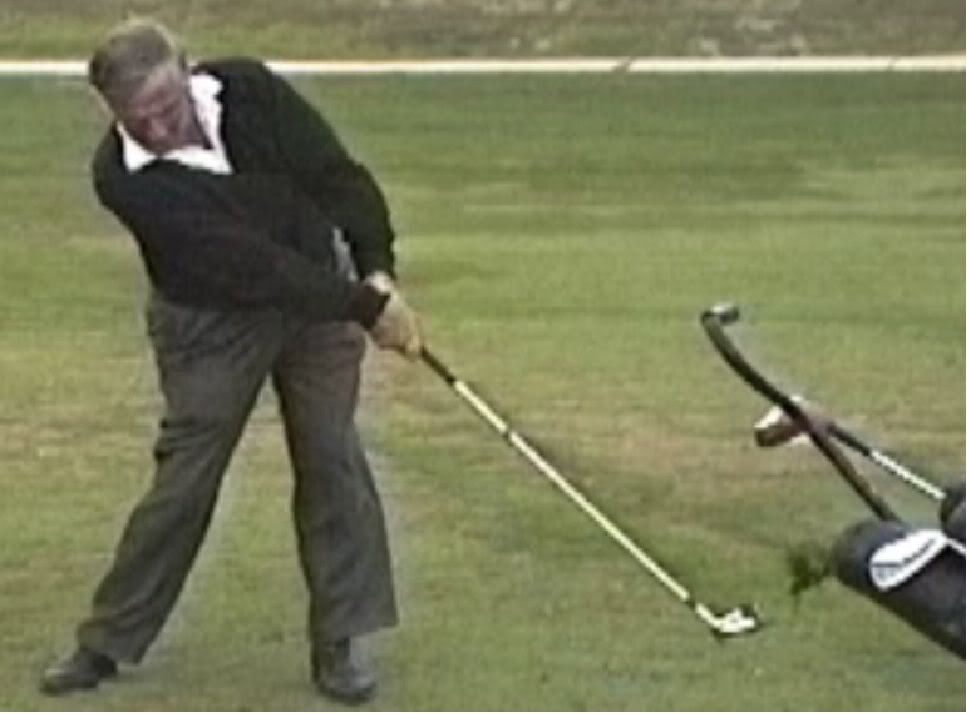
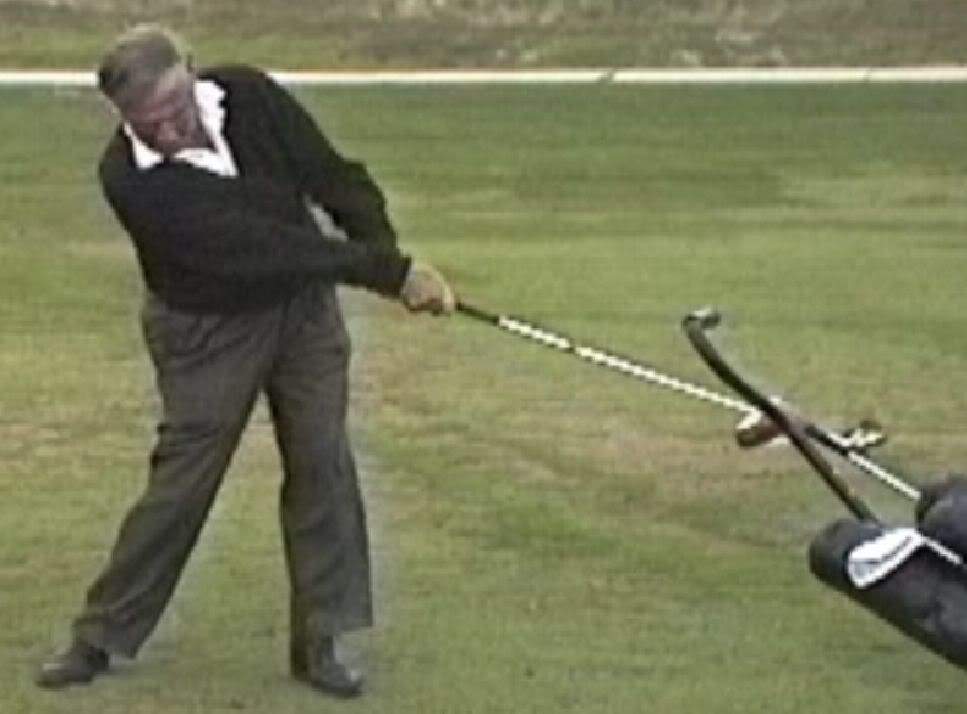
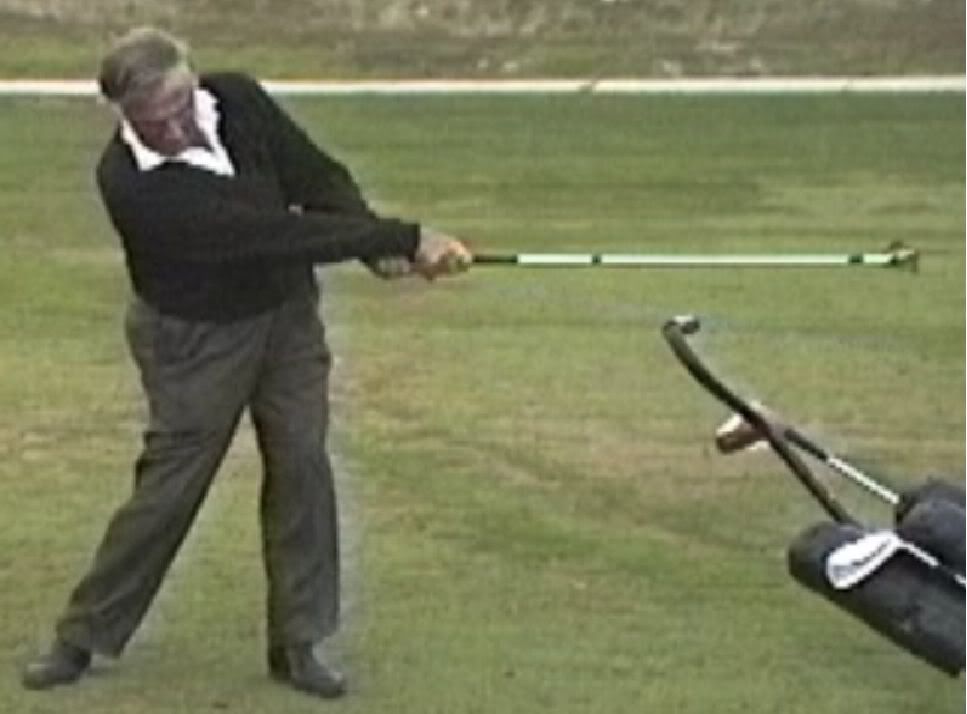
Here are three enlargements of the Finish Swivel.

The first illustrates the exit from the Follow-Through (Both Arms Straight Position). The Wrists have begun their rotation from their 'Vertical (perpendicular) to the ground' alignment during the Impact Hinge Action into their 'parallel to the Plane' alignment during the Finish Swivel. The Hands are waist-high, and the Clubshaft is parallel to the ground (and also to the Plane Line).

The second and third photos show the momentum-induced move past 'parallel to the plane' to almost horizontal. This occurs only as the Hands approach chest-high and the Clubshaft points skyward (and also to the Plane Line). Many make the serious mistake of executing this Action through Impact. This is Clubhead Throwaway: An Over-Roll that puts the Clubshaft out of line with the Left Arm -- loss of Rhythm (RPM) -- just as surely as does a Bent Left Wrist. Avoid both.

Note that the Left Wrist has remained Flat. Also, the Right Arm has straightened through Impact and has remained that way deep into the Finish. That is possible only with Extensor Action.

The Ball was well-compressed and went dead straight.

I was not born with these mechanics. Far from it. But, I did learn them, and you can, too.

By the way, the figure in the background is Ben Doyle, the first Authorized Instructor of The Golfing Machine. He has taught the Finish Swivel for almost fifty years, and I think he would give this one 'two thumbs up.'


Lynn truly outstanding work...yes Hinge action and Finish swivel very different indeed...

However very important points to consider...

#1) Finish Swivel is parallel to the Selected Plane Angle...I see so many over swivel to the finish ...both off plane with the Hands and the sweetspot and shaft planes....Reulting in the dreaded "Count Dracula" Finish...

#2) Many argue here that the left wrist must still be "Flat" but I beg to differ using the Grip Type variation as the ever present "Trump Card"

#3) Although I respect my elders in TGM..just like there is Perverted Pitch Elbow, Perverted Axis Tilt...I am now proclaiming that there can be a Perverted Finish Swivel...I don't really care how many years someone has taught something it can be misrepresented...For Example the Flying Wedges?


Lesson I've learned the most in life and G.O.L.F.:...Don't be perverted!!!....Bucket?


I thought your demonstration of Finish Swivel was more accurate and concise at Pine Needles than what has been demonstrated after your Canton experience with the Grand Pooh Bah.

But point is well made and very well demonstrated...


Don't execute Impact as a Swivel...

But in reality there is a Hinge Action between Release Swivel and Finish Swivel for the Swinger...


Annikan
That was cool
Yoda,

Thank you for spending so much time on this at the "Old Waverly" seminar. The finish swivel concept became clear with the help of three learning experiences.

The time line was:

First. V.J.’s computer illustrating low point and the #3 pressure point that Must continue on-plane after impact. Impact is further down plane than I thought.

Second. Ted using the Hula Hoop and a rod to demonstrate low point, divot depth, ball position and the #3 pressure point that must continue on-plane after impact. Impact is further down plane than I thought.

Third. Yoda, taking my hands, shoulders and arms, moving them through the motion over and over until I could see and feel how far down-out-and-forward-on-plane the hinging motion travels (rhythm) before the finish swivel. Impact is further down plane than I thought.

This is "The Golfing Machine". Hinging and the finish swivel and EXTENSOR action. I never could or would have learned this on my own and it’s the difference between hackers and golfers.
You must Hinge first, and only then Swivel.


"

QUOTE]

Ok I am lost, is this statement for the backswing or the downswing?
Originally Posted by annikan skywalker

...I am now proclaiming that there can be a Perverted Finish Swivel...I don't really care how many years someone has taught something it can be misrepresented...

I thought your demonstration of Finish Swivel was more accurate and concise at Pine Needles than what has been demonstrated after your Canton experience with the Grand Pooh Bah.
For the record, George Preisinger, then Head Professional at the Marietta Country Club in Marietta, Georgia -- not Ben Doyle at Canton -- taught me Swivel Action in 1963. I was 17 years old. Unfortunately, it was not until I got on the phone with Homer Kelley in 1980 that I learned to differentiate Swivel Action (after the Follow-Through) from Hinge Action (during Impact). I was 34 years old.

In between I hit some 800,000 practice balls. And that's a conservative number. There were many good shots, but my understanding was incomplete and it showed. What a waste.

And now, 25 years and probably another 800,000 practice balls later, I think I know the difference between the two. I have described that difference clearly in countless posts -- including those most recent above -- and now have illustrated it in both still sequence and video.

The only difference between the Hinge Action and Finish Swivel you see in this video -- both, by the way, executed with a Strong Single Action Grip (Wristcock Only, no Wrist Bend) -- and the ones I photographed and sent to Homer Kelley in 1982 and later still those demonstrated in the first 'night-time' videos (late 2004) now on this site -- is the camera angle. And, at least according to my own understanding...

Both are correct.
Originally Posted by tongzilla Regarding the Finish Swivel, I couldn't quite remember what Ben taught at Canton, but was it something like this?


I must not Know what I'm doing.... because if the clubface should look to the ground with the Correct Finish Swivel..then I really just don't know anything about TGM....So...I will continue my learning...Onward!!!
Originally Posted by tongzilla

What Grip Type would you say Ben uses?
Lynn....thank you very much for this little gem...i have been lacking this in my swing and as soon as i incorporated this my ball striking went up another level...now it just flows start to finish delivery line roll prep ..music to my ears ...goose bumps when i hit it
Originally Posted by sdsurfmore
Lynn....thank you very much for this little gem...i have been lacking this in my swing and as soon as i incorporated this my ball striking went up another level...now it just flows start to finish delivery line roll prep ..music to my ears ...goose bumps when i hit it
That's great news, sd. If the time comes when you start Hooking it off the planet, just tone down the Swivel a bit and make sure you get a good Hinge Action. First though, make sure you are executing a true, Inside-Out (Down Plane) Downstroke. If the 'Out' is lacking, the Ball will go left!

The Finish Swivel is so important. I've told the story before in these pages about the Finish Swivel lesson Homer Kelley once gave a student. He said he "learned more about Golf on that day than on any other." Considering the Golf water under his bridge, that's saying a lot.

Later in the week we will post video where I explain and demonstrate the principles of Swivel Action and the three Hinge Actions. Stay tuned...
my divots are inside to out..the in-line condition is a great feeling and a constant reminder of what it feels like...my hooked shot came from losing lag pressure...this was a part of the instruction that i didn't absorb last year during the SO Cal school but i'm sure glad i got it now..Thanks Lynn
Originally Posted by sdsurfmore
my divots are inside to out...
Divots indeed are taken 'Down and Out' (1-L #14), but they should not point to the right of the Target. If they do, then you have executed a Closed Plane Line (10-5-E) and, depending on Clubface alignment, the Ball Flight (both initial Direction and Path) will be subject to any number of vagaries.

Remember, you are at the bottom of a circle (Clubhead Orbit) with a radius (Left Arm and Club) some five feet in length. Accordingly, there is not a lot of 'Down' and not a lot of 'Out' left. And some of that Divot is the Club exiting the ground after Low Point and now traveling 'Up and In'. So, while the 'Outward' dimension of Impact is still present and extremely necessary to achieve, it is not enough to send the Divot out to the right.

The goal is a Three-Dimensional Impact -- Downward, Outward and Forward -- and an On Line Divot.
Mathew, maybe you should watch Ben hit balls in person...then maybe you can comment upon his clubface control.......
Originally Posted by Michael Finney Mathew, maybe you should watch Ben hit balls in person...then maybe you can comment upon his clubface control.......
There have been great players throughout history doing things that aren't correct and just because they were great doesn't mean its right. Just because one does well using inferior alignments doesn't mean it is the simpliest way. That is why I love the golfing machine. I know he hits the ball well but it doesn't change that fact.

We're talking about the advancement of a sport, to keep on inspiring, to improve and to make the next generation play better. Do you not see what Homers vision was about and why he spent 40+ years working out the simpliest way to do things. I couldn't care less what Ben does, Tiger Woods does or any tour player for that matter - its about the simplicity of a machine and it is that which is going to advance the next generation of golfers.
Skeptics never let dogma dictate knowledge and learning, and skeptics always question those who claim that they have THE truth. Skeptics challenge, prod, poke, inquire and strive. So, yes, I am a skeptic. Always.
Originally Posted by Vandal Skeptics never let dogma dictate knowledge and learning, and skeptics always question those who claim that they have THE truth. Skeptics challenge, prod, poke, inquire and strive. So, yes, I am a skeptic. Always.
I used to be a skeptic when I was younger. Now I just want to have fun. I gave up challenging, prodding and poking, for distance, accuracy and trajectory. But hey, I'm glad that someone is following in my old footsteps. Long live the 60's.
Originally Posted by Mathew There have been great players throughout history doing things that aren't correct and just because they were great doesn't mean its right.
Yes it does! Just because a swing doesn't look like Ben Hogans doesn't mean it's wrong (I know you didn't say Ben Hogan) but that is what is implied.

That's the whole point and beauty of Homer Kelley's golfing machine, there are a zillion (I know it's not a zillion) different ways to 'Do It'. And, the most ideal way might not be possible for some (for whatever reason be it physical or mental) so they find another.
Originally Posted by Tom Bartlett Yes it does! Just because a swing doesn't look like Ben Hogans doesn't mean it's wrong (I know you didn't say Ben Hogan) but that is what is implied.

That's the whole point and beauty of Homer Kelley's golfing machine, there are a zillion (I know it's not a zillion) different ways to 'Do It'. And, the most ideal way might not be possible for some (for whatever reason be it physical or mental) so they find another.
Read it, how can you not see it! There is a mechanical model underlying the whole entire book! You have to conform to the principles and alignments of the machine to have a precision stroke, conforming to the exact same principles you use in daily life and mechanical alignments you must adhere to if you want to be that efficient ballstriking machine. The book is written so that a player can have options in the various ways you can adjust it without compensations. A compensation is something that causes a disadvantage without any advantages in return or that any advantage is so overly outweighed it ceases to be one. If the impact interval is preformed as a swivel, it is a compensation. On a shot by shot basis 'the results' may even seem to be very similiar when expertly executed but every once in a while it will catch up with you and the price will be paid. Remember it is our role to give the Tiger Woods of tommorow the means and information so that he has an edge to enable him to break the records of Tiger Woods today inorder to keep inspiring the whole next generation of players that will play this game and not just merely copy the masters of old. Your stuck in the past learning the faults of your elders, and (until the next generation produces something even better) the golfing machine is advancing the future! Homer Kelley worked it out, he saw it, he understood it and the book is a proof to those that understand it!
Originally Posted by Mathew Read it, how can you not see it! There is a mechanical model underlying the whole entire book! You have to conform to the principles and alignments of the machine to have a precision stroke, conforming to the exact same principles you use in daily life and mechanical alignments you must adhere to if you want to be that efficient ballstriking machine. The book is written so that a player can have options in the various ways you can adjust it without compensations. A compensation is something that causes a disadvantage without any advantages in return or that any advantage is so overly outweighed it ceases to be one. If the impact interval is preformed as a swivel, it is a compensation. On a shot by shot basis 'the results' may even seem to be very similiar when expertly executed but every once in a while it will catch up with you and the price will be paid. Remember it is our role to give the Tiger Woods of tommorow the means and information so that he has an edge to enable him to break the records of Tiger Woods today inorder to keep inspiring the whole next generation of players that will play this game and not just merely copy the masters of old. Your stuck in the past learning the faults of your elders, and (until the next generation produces something even better) the golfing machine is advancing the future! Homer Kelley worked it out, he saw it, he understood it and the book is a proof to those that understand it!
Thank you, Mathew, for your contribution.
Originally Posted by Tom Bartlett Yes it does! Just because a swing doesn't look like Ben Hogans doesn't mean it's wrong (I know you didn't say Ben Hogan) but that is what is implied.

That's the whole point and beauty of Homer Kelley's golfing machine, there are a zillion (I know it's not a zillion) different ways to 'Do It'. And, the most ideal way might not be possible for some (for whatever reason be it physical or mental) so they find another.
I thought he meant Ben Doyle
By the way,is there anyone out there who can give an example of where Mr Kelly went wrong? or ..give one instance (other than clarification)what he got wrong?( in terms of facts)AND PROVE IT!. (I am ve..ry skeptical by nature btw).
Originally Posted by Mathew There have been great players throughout history doing things that aren't correct and just because they were great doesn't mean its right. Just because one does well using inferior alignments doesn't mean it is the simpliest way. That is why I love the golfing machine. I know he hits the ball well but it doesn't change that fact.

We're talking about the advancement of a sport, to keep on inspiring, to improve and to make the next generation play better. Do you not see what Homers vision was about and why he spent 40+ years working out the simpliest way to do things. I couldn't care less what Ben does, Tiger Woods does or any tour player for that matter - its about the simplicity of a machine and it is that which is going to advance the next generation of golfers.
Amen to that Mathew...he that have ears to hear, let him hear.
But then again....

Homer is not god....

And this isn't the USSR....you don't HAVE TO conform to anything....

...

And Ben's swing, for him, produces straight shots. I just don't see how anyone could say that that is FLAT-OUT WRONG! (BLASHPEMY!!! HOMER'S ROLLING IN HIS GRAVE!!! YARRRGH!)

...

I'm sure he's aware of, and has tried thouroughly, all methods of clubface control.....

...

For the record, I don't support one way solely.....

I support what works best for a person. Brian, for one, says he teaches all ways...

...

Also, for the record, I find Ben's Swivel a little strange, for me.....but I like Angled Hinges anyway....and any Horizontal Hinge is really not my specialty (starting to work on it more).

Then again, I haven't seen these guys teach slicers how not to slice (that seems to be a big part of this whole debate, and the usefulness of this move...i.e. as a tool to educate the hands).

....so I'm not gonna assume that they don't know what they're talking about.