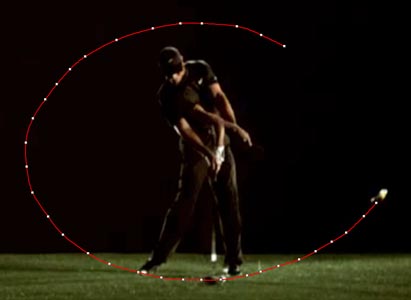
Pivot center

In another thread, Yoda stated that a golfer needs a i) pivot center and that the pivot center needs to be centralised between the feet.

Of all HKs' ideas I have never understood why there needs to be a pivot center for the swinging arms/clubshaft.

I can understand a grandfather clock having a pivot center located at the fulcrum of the pendulum because i) the length/radius of the pendulum arm is constant and ii) the low point of the pendular arc is constant.

However, golfers don't have a consistent ball position and/or a consistent low point - relative to the center of their stance. Also, the length (radius) of the left arm/clubshaft swinging structure varies continuously during the downswing. Also, the fulcrum (left shoulder socket) of the left arm/clubshaft structure moves in space continuously and has a variable distance from the required low point (a set number of inches ahead of the ball). Also, although the low point of the swing is roughly opposite the left shoulder socket area, the left arm/clubshaft length/radius is not necessarily at its greatest value at that time point. The left arm/clubshaft's length/radius is at its greatest value when the left arm is maximally straight and the clubshaft is maximally straight-in-line with the left arm, and that occurs at the end of the followthrough.

Maybe that is why HK didn't state that a stationary head is an imperative, but more imprecisely classified it as an essential requirement. Rhythm and balance are also imprecise concepts that are classified as essential requirements.

To make any further discussion interesting/informative, I am including a series of photos showing the pivot center of different golfers. I drew red lines through the pivot center (defined as a point midway between the shoulders) at address. I then left the red line constant, and captured two additional images - at the end-backswing and at impact.

From this swing video -


Gary Player
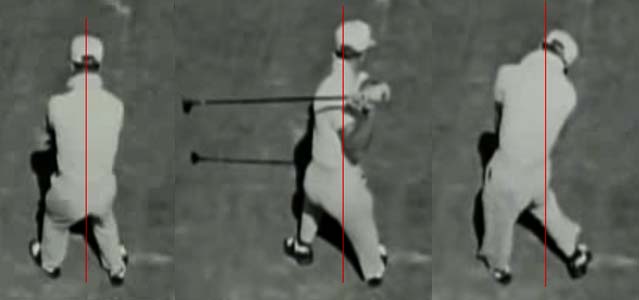


Arnold Palmer
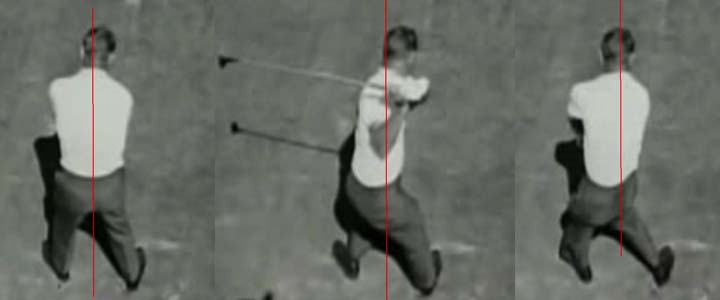


Jack Nicklaus
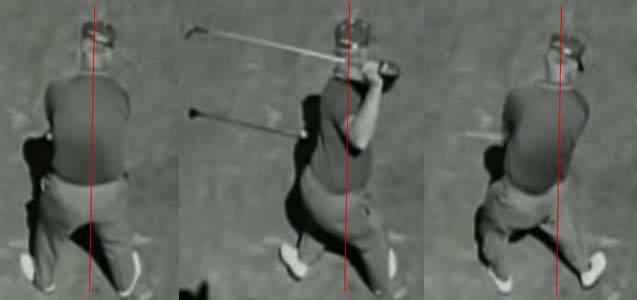


Mike Souchak
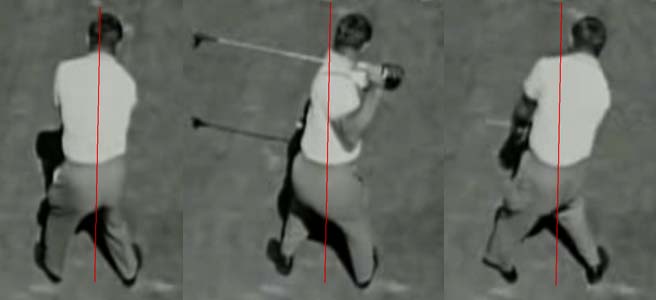


Here is another swing video that is pertinent to this discussion

From this Natalie Gulbis/Paula Creamer swing video -


Natalie Gulbis
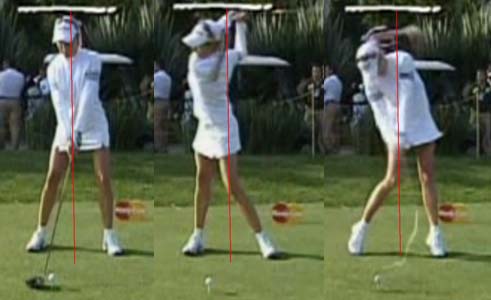


Paula Creamer
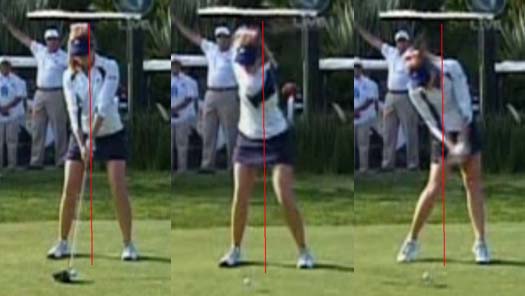


If I were considering essential requirements (and not imperatives) for a golf swing, I would consider removing "stationary head" and inserting "set distance of the left shoulder socket from the ball at impact".

Jeff.
I think (unless both girls play with the ball way back in the stance) that because of the angle from which the photos are taken, the pics of Creamer and Gulbis aren't very useful.
Even though the camera angle was not square, one can certainly see that both of the young ladies do not keep their head, or upper swing center, stationary. Check the swing video for a DTL view to see how much their heads drop. It's a staggering amount. They do not have any pivot center to their swings.

Jeff.
Hmmmm...... I'll take the "Big 3" over Souchak/Gulbis/Creamer any day.

On second thought..... you know that move by Gulbis does look quite "golf-like".... I wonder if I shouldn't work on that.

Jeff - can you please tell me how to go about it? Looks like it might be the way to go.
Cometgolfer

I think that you are missing the point. I am not recommending that anybody emulate the Gulbis/Creamer approach. I only posted their swings as extreme examples of golfers who don't have a stationary head and who don't have anything resembling a pivot center in their swing, and yet they can consistently hit the ball well enough to play at a professional level. The question that it raises is what is the primary function of a i) stationary head; ii) a pivot center; and does the pivot center have to centralised between the feet throughout the swing.

You are free to express your opinions on this issue.

Jeff.
Originally Posted by Jeff Cometgolfer

I think that you are missing the point. I am not recommending that anybody emulate the Gulbis/Creamer approach. I only posted their swings as extreme examples of golfers who don't have a stationary head and who don't have anything resembling a pivot center in their swing, and yet they can consistently hit the ball well enough to play at a professional level. The question that it raises is what is the primary function of a i) stationary head; ii) a pivot center; and does the pivot center have to centralised between the feet throughout the swing.

You are free to express your opinions on this issue.

Jeff.
Professional golf is a math contest. Two of the best ballstrikers on tour last year, Riegger and Durant, lost their cards. This forum is about hitting the ball at the target in an efficient and uncompensated way. Yes, you can move your head. Yes, you can compensate for that. But why would you want to?
Originally Posted by Jeff
In another thread, Yoda stated that a golfer needs a i) pivot center and that the pivot center needs to be centralised between the feet.

Of all HKs' ideas I have never understood why there needs to be a pivot center for the swinging arms/clubshaft.
To maintain the Point of Compression (2-C-0) through Impact and for consistent Directional Control (2-D-0), there must be a Centered Arc. Or, a "compensating manipulation". In turn, a Centered Arc requires that both the Pivot and the Arm/Clubshaft Swing be Centered. In other words, the Pivot has its Center, and the Primary Lever Assembly (Left Arm and Club) has its Center. They are not the same.


Originally Posted by Jeff
I can understand a grandfather clock having a pivot center located at the fulcrum of the pendulum because i) the length/radius of the pendulum arm is constant and ii) the low point of the pendular arc is constant.
Yes, this is the mechanical ideal. A centered arc with a constant radius and a low point directly opposite the hinge pin.

Originally Posted by Jeff However, golfers don't have a consistent ball position and/or a consistent low point - relative to the center of their stance.
A Centered Arc is indifferent to Ball Location and Stance. Hence, Low Point also is indifferent.

Originally Posted by Jeff Also, the length (radius) of the left arm/clubshaft swinging structure varies continuously during the downswing.
Ideally, the Left Arm remains fully-extended from Start Up to the end of the Follow-Through (6-A-4). The Left Wristcock shortens the Radius (Left Arm and Club) to produce Power through mechanical advantage (2-P; The Glossary / Lever Assemblies and Wristcock).

Originally Posted by Jeff Also, the fulcrum (left shoulder socket) of the left arm/clubshaft structure moves in space continuously and has a variable distance from the required low point (a set number of inches ahead of the ball).
Indeed, the Left Shoulder ideally is moving in a circle. This requires its own Center (either the Head or the 'Point between the Shoulders'). Otherwise, the Clubhead Arc becomes Uncentered (2-H).

Originally Posted by Jeff Also, although the low point of the swing is roughly opposite the left shoulder socket area, the left arm/clubshaft length/radius is not necessarily at its greatest value at that time point. The left arm/clubshaft's length/radius is at its greatest value when the left arm is maximally straight and the clubshaft is maximally straight-in-line with the left arm, and that occurs at the end of the followthrough.
Actually, the Left Arm and Clubshaft Radius is at Full Extension within one inch past Impact (2-D-0 / 7th edition). It is this "Right" Timing (6-F-1) that produces Maximum Compression "near -- but prior to -- Full Extension". This Full Extension is independent of the Follow-Through, which by definition (8-11) requires that the Right Arm also be straight (6-A-4).

Originally Posted by Jeff Maybe that is why HK didn't state that a stationary head is an imperative, but more imprecisely classified it as an essential requirement. Rhythm and balance are also imprecise concepts that are classified as essential requirements.
There is nothing imprecise in Mr. Kelley's terminology, classifications or concepts. The nearest dictionary will provide the necessary "standard of precision" (1-H) for the chosen terminology and classifications. Deliberately using that 'dictionary English' (Preface) -- as opposed to scientific or engineering jargon -- the book itself defines the concepts of Stationary Head, Balance and Rhythm. Its intentional brevity demands that the complete definition of any concept be the sum of all the available references (1-H). Nevertheless, an adequate definition for each is given in The Glossary.

Originally Posted by Jeff To make any further discussion interesting/informative, I am including a series of photos showing the pivot center of different golfers. I drew red lines through the pivot center (defined as a point midway between the shoulders) at address. I then left the red line constant, and captured two additional images - at the end-backswing and at impact.

From this swing video -


Gary Player


Arnold Palmer


Jack Nicklaus


Mike Souchak


Here is another swing video that is pertinent to this discussion

From this Natalie Gulbis/Paula Creamer swing video -


Natalie Gulbis


Paula Creamer


Regarding the males, perhaps there is a mechanical reason why Mr. Souchak, as good as he was, never won a major championship. Regarding the females, well, let's just say that their actions are "less than ideal" and require a good deal of "compensating manipulation" (see 1-K and my first answer above).

Originally Posted by Jeff If I were considering essential requirements (and not imperatives) for a golf swing, I would consider removing "stationary head" and inserting "set distance of the left shoulder socket from the ball at impact".
Mr. Kelley understood that the Left Shoulder is higher at Impact (7-8 ) than in the normal Adjusted Address position (8-3). Further, he gave us a comprehensive three-step routine for accomplishing that specific objective with unprecedented precision (2-J-1). Fortunately, he understood that these adjustments were a means to an end -- creating a uniform Arc -- and not the end in themselves.


Originally Posted by Yoda Actually, the Left Arm and Clubshaft Radius is at Full Extension within one inch past Impact (2-D-0 / 7th edition).
Here is the exact quote:
"The Lever Assembly is seldom more then an inch from Full Extension at Impact".
Originally Posted by Mike O
Here is the exact quote:
"The Lever Assembly is seldom more then an inch from Full Extension at Impact".

Agreed, Mike: There is a difference between my conclusion (point of Full Extension past Impact) and the "exact [Kelley] quote" (degree of Extension at Impact). For practical purposes, I believe that my conclusion is valid.

Remember, the Left Wrist doesn't go from Cocked to Level -- then hang around a while -- and later proceed to its Uncocked condition. No sir, the Left Wrist is rapidly Uncocking -- perpendicular Wrist MOTION (4-0 / 4-B) -- and it is Releasing in one unbroken thrust. Even with the Swinger's Sequenced Release (4-D-0), there is an overlapping of the #3 Accumulator Wrist Roll and completion of the #2 Accumulator Wrist Uncocking.

In any event, the Left Wrist ideally is Level at Impact and then immediately proceeds down approximately one inch to fully-Uncocked through the Impact interval. No way does this complete Uncocking take until the end of the Follow-Through (which was Jeff's point).

Mike . . .

I don't want to get too far from the subject of this thread, but since you've raised the question . . .

If at Impact, the Primary Lever has only one inch to go until it reaches Full Extension, and if the Left Wrist is Releasing freely, then what is your best guess as to when Full Extension occurs, i.e., how far past Impact?

Originally Posted by Yoda
Mike . . .

I don't want to get too far from the subject of this thread, but since you've raised the question . . .

If at Impact, the Primary Lever has only one inch to go until it reaches Full Extension, and if the Left Wrist is Releasing freely, then what is your best guess as to when Full Extension occurs, i.e., how far past Impact?

Whenever the #3 accumulator becomes the smallest.
Originally Posted by Mike O
Whenever the #3 accumulator becomes the smallest.
Agreed.

In Homer-speak, that would be zero.

Yoda

This is one heck of a post.

Jeff your persistence does bring out the best from the best. But what is the nature of this mission that you are on?

O.B.
Originally Posted by O.B.Left Yoda

This is one heck of a post.

Jeff your persistence does bring out the best from the best. But what is the nature of this mission that you are on?

O.B.
O.B.,
Since Jeff will give you some story about searching out the truth et.c etc. Let me answer this for you - his mission is to drive people insane- Bucket and I have him on a retainer fee for this exact purpose.
Originally Posted by Mike O O.B.,
Since Jeff will give you some story about searching out the truth et.c etc. Let me answer this for you - his mission is to drive people insane- Bucket and I have him on a retainer fee for this exact purpose.
Looks like its workin just fine Mike. But I've got this feeling that you and Bucket are like re reading these posts just for kicks, cause you guys are even more totally friggin nuts. Careful you dont overdue it there on your own medicine.

Secrets in the sauce.


O.B.
Originally Posted by O.B.Left Looks like its workin just fine Mike. But I've got this feeling that you and Bucket are like re reading these posts just for kicks, cause you guys are even more totally friggin nuts. Careful you dont overdue it there on your own medicine.

Secrets in the sauce.
O.B.
Well said but I'm still putting you on my list! No not that list- this list I went to look at Jeff's swinging video but got sidetracked with Sasha is a goddess.
Yoda - you wrote-: "To maintain the Point of Compression (2-C-0) through Impact and for consistent Directional Control (2-D-0), there must be a Centered Arc. Or, a "compensating manipulation". In turn, a Centered Arc requires that both the Pivot and the Arm/Clubshaft Swing be Centered. In other words, the Pivot has its Center, and the Primary Lever Assembly (Left Arm and Club) has its Center. They are not the same."

I can understand that there are two centers of rotation - one for the pivot's center and one for the arm/clubshaft's center, but you have not explained why they both have to centered between the feet to create a centered clubhead arc.

First of all, the left arm/clubshaft has a fulcrum point at the left shoulder socket joint. However, the clubhead does not circumscribe a perfect circle around the left shoulder socket (because the clubshaft has an angle relative to the left arm that varies from 90 degrees at the start of the downswing to 0 degrees at the low point).

Secondly, the left shoulder socket has a variable relationship to the pivot center (base of the neck) during the downswing.

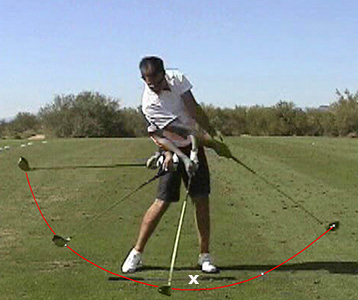
It's like there are two intersecting circles of rotation - left shoulder socket relative to the pivot center (where the radius is likely to be constant) and left shoulder socket to the clubhead (where the radius is constantly changing). These two circles are moving at different speeds in the downswing, and hopefully, the clubhead arc will end up being relatively circular (actually more likely to be slightly elliptical) with its low point ending up a desired distance ahead of the ball position. So, for example, if the ball is placed 4" inside the left foot, then the low point needs to be "x" inches ahead of the ball position. However, in this model - there is no necessary requirement regarding the two circles of rotation (that are both in constant motion) that the pivot center must be perfectly centralized in the stance.

Here is the downswing clubhead arc of Aaron Baddeley's swing.


Point "X" is the low point of the clubhead arc. Note that the pivot center (base of the neck) is not centralised in the stance.

Here is the downswing clubhead arc of Tiger Woods swing.


Note that the clubhead arc is elliptical. Note that the low point is at the ball position. Note that Tiger's pivot center (base of neck) is not centralized between his feet.

Jeff.
Originally Posted by Jeff Yoda - you wrote-: "To maintain the Point of Compression (2-C-0) through Impact and for consistent Directional Control (2-D-0), there must be a Centered Arc. Or, a "compensating manipulation". In turn, a Centered Arc requires that both the Pivot and the Arm/Clubshaft Swing be Centered. In other words, the Pivot has its Center, and the Primary Lever Assembly (Left Arm and Club) has its Center. They are not the same."

I can understand that there are two centers of rotation - one for the pivot's center and one for the arm/clubshaft's center, but you have not explained why they both have to centered between the feet to create a centered clubhead arc.

First of all, the left arm/clubshaft has a fulcrum point at the left shoulder socket joint. However, the clubhead does not circumscribe a perfect circle around the left shoulder socket (because the clubshaft has an angle relative to the left arm that varies from 90 degrees at the start of the downswing to 0 degrees at the low point).

Secondly, the left shoulder socket has a variable relationship to the pivot center (base of the neck) during the downswing.

It's like there are two intersecting circles of rotation - left shoulder socket relative to the pivot center (where the radius is likely to be constant) and left shoulder socket to the clubhead (where the radius is constantly changing). These two circles are moving at different speeds in the downswing, and hopefully, the clubhead arc will end up being relatively circular (actually more likely to be slightly elliptical) with its low point ending up a desired distance ahead of the ball position. So, for example, if the ball is placed 4" inside the left foot, then the low point needs to be "x" inches ahead of the ball position. However, in this model - there is no necessary requirement regarding the two circles of rotation (that are both in constant motion) that the pivot center must be perfectly centralized in the stance.

Here is the downswing clubhead arc of Aaron Baddeley's swing.


Point "X" is the low point of the clubhead arc. Note that the pivot center (base of the neck) is not centralised in the stance.

Here is the downswing clubhead arc of Tiger Woods swing.


Note that the clubhead arc is elliptical. Note that the low point is at the ball position. Note that Tiger's pivot center (base of neck) is not centralized between his feet.

Jeff.


"WhhhoooooWWAAAHH!!! Have mercy! This thang's killin' me!"


In 2-H Mr. Kelley wrote, ‘Though the “Head” Pivot Center is recommended, it is not at all mandatory. The important thing is that the true Swing Center for ALL COMPONENTS is around a Hinge Pin with one end at the top of the Stationary Head and the other in the ground, precisely between the feet, with no regard for Body Location or Position at any time.’
You can move your head if you choose to but what advantage is it?
Why not keep it stationary?
It is too bad that Gulbis, Creamer, Woods, Baddeley and others do not set their head at impact fix.
Originally Posted by BCGolf In 2-H Mr. Kelley wrote, ‘Though the “Head” Pivot Center is recommended, it is not at all mandatory. The important thing is that the true Swing Center for ALL COMPONENTS is around a Hinge Pin with one end at the top of the Stationary Head and the other in the ground, precisely between the feet, with no regard for Body Location or Position at any time.’
You can move your head if you choose to but what advantage is it?
Why not keep it stationary?
It is too bad that Gulbis, Creamer, Woods, Baddeley and others do not set their head at impact fix.
Yes and why did Homer choose the stationary head? Because he used his eyes focused on the ball as the easiest way for the golfer to determine if the head was stationary or not.
Originally Posted by Jeff
Yoda -

I can understand that there are two centers of rotation - one for the pivot's center and one for the arm/clubshaft's center, but you have not explained why they both have to centered between the feet to create a centered clubhead arc.
Who said that? Not me!

Originally Posted by Jeff
Here is the downswing clubhead arc of Tiger Woods swing.


Note that the clubhead arc is elliptical.
More 'old news'. Homer Kelley wrote forty years ago:
"The point may be made that it is impossible to inscribe perfect circles while the center -- that is the turning shoulder -- is in motion. The straight line requirements of the Compression Point are satisfied as long as the Lever Assembly Center [Yoda note: Left Shoulder] is moving in a circle during Impact . . ." (2-H)
Originally Posted by jeff
Note that the low point is at the ball position.
That's because the Ball Position is opposite the Low Point . . . the Left Shoulder.


BTW, as long as we're 'noting', let's note that Tiger's 2007 Ball Position is well ahead of its position in the January 2001 Golf Digest "Head 'Oh So Far' Behind the Ball" sequence posted in another thread). See my responsive post: Tiger's Journey. Remember? If not, see #8 here: http://lynnblakegolf.com/forum/showt...8805#post58805. In contrast, while you're at it, compare my view to Jim Flick's congratulatory comments http://www.book4golf.com/lessons/.

C'mon, Jeff. Give us something new. Not just your incomplete conclusions as to 'what is' framed by "I found it"!