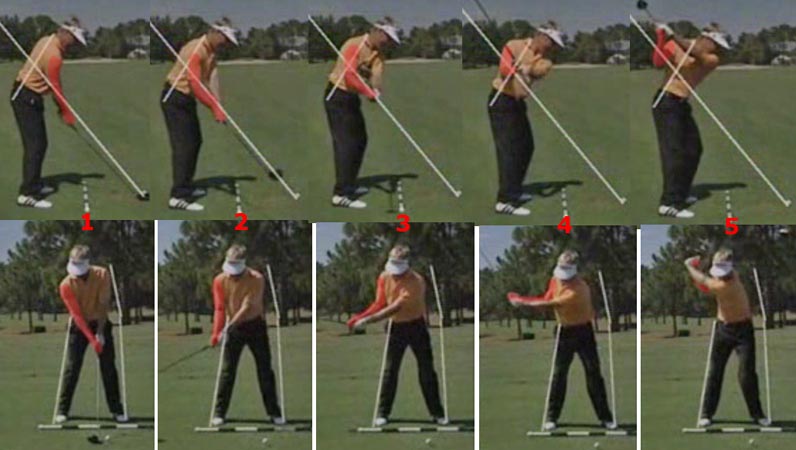
Right forearm takeaway

I am presently writing a TGM-influenced review paper for my personal golf website regarding arm movements in the golf swing, and I have been thinking a lot about the best way of teaching an optimum takeaway movement.

I favor the "right forearm takeaway" move that I learnt about here. However, there are different ways of teaching/conceptualising that movement. I noted that VJ Trolio in Yoda's Alignment Golf DVD talked about making a lawnmower move. However, I think that it predisposes to a push action elbow position, rather than ensuring the "correct" fanning motion of the right forearm.

I have therefore described a takeaway move in my review paper, which I call a "right clap hand action".

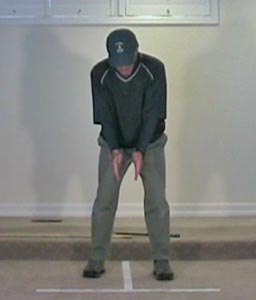
Here are two photographs of me demonstrating the right clap hand action.

This is my address position with the palms facing each other ready to clap hands.


The next photo demonstrates the right clap hand motion.
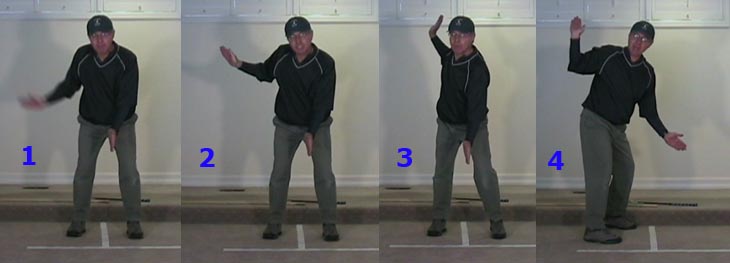


Image 1 shows the right upper limb moving in space while performing the clap hands action. Note how the right upper arm naturally moves away from the torso during the action, and note how the right forearm fans out.

Image 2 shows the back-limit of the hand clap action if I do not allow the upper and lower torso to move. In other words, I cannot get my right hand further back than that position if I keep my lower and upper torso square to the ball-target line.

Image 3/4 shows how far the right hand can go back if I allow my upper and lower torso to rotate freely (to about a 45 degrees pelvic rotation and a 80-90 degrees shoulder rotation) while performing the right hand clapping action. Note that the right hand ends up behind the right shoulder with the right forearm vertical to the ground. If a golfer has the flexibility to get to that position, then he should be in the perfect end-backswing position (for a swinger).

What do you think of my "method" of executing/teaching a takeaway action?

Is there a better way to describe/teach the right forearm takeaway?

Jeff.
Originally Posted by Jeff
I noted that VJ Trolio in Yoda's Alignment Golf DVD talked about making a lawnmower move. However, I think that it predisposes to a push action elbow position, rather than ensuring the "correct" fanning motion of the right forearm.

Jeff.
Which Yoda was quick to tell.

Have you seen Annikan“s (David Orr) clip in the gallery?
Originally Posted by Jeff I am presently writing a TGM-influenced review paper for my personal golf website regarding arm movements in the golf swing, and I have been thinking a lot about the best way of teaching an optimum takeaway movement.

I favor the "right forearm takeaway" move that I learnt about here. However, there are different ways of teaching/conceptualising that movement. I noted that VJ Trolio in Yoda's Alignment Golf DVD talked about making a lawnmower move. However, I think that it predisposes to a push action elbow position, rather than ensuring the "correct" fanning motion of the right forearm.

I have therefore described a takeaway move in my review paper, which I call a "right clap hand action".

Here are two photographs of me demonstrating the right clap hand action.

This is my address position with the palms facing each other ready to clap hands.


The next photo demonstrates the right clap hand motion.


Image 1 shows the right upper limb moving in space while performing the clap hands action. Note how the right upper arm naturally moves away from the torso during the action, and note how the right forearm fans out.

Image 2 shows the back-limit of the hand clap action if I do not allow the upper and lower torso to move. In other words, I cannot get my right hand further back than that position if I keep my lower and upper torso square to the ball-target line.

Image 3/4 shows how far the right hand can go back if I allow my upper and lower torso to rotate freely (to about a 45 degrees pelvic rotation and a 80-90 degrees shoulder rotation) while performing the right hand clapping action. Note that the right hand ends up behind the right shoulder with the right forearm vertical to the ground. If a golfer has the flexibility to get to that position, then he should be in the perfect end-backswing position (for a swinger).

What do you think of my "method" of executing/teaching a takeaway action?

Is there a better way to describe/teach the right forearm takeaway?

Jeff.

Jeff . . . looking at the pictures . . . why wouldn't you just swing like that? Pivot looks good . . . you don't have that whacking looking lifting deal going. Not sure about all the verbage . . . but the pictures look good. You got any with a club in your hands while you do that?
Jeff,

You are on the right track.
I suggest practicing with your right palm parallel to the plane line at the top and while in motion, keep it parallel until it reaches the release point.
You may also consider moving your hands to impact fix, because hopefully your address hands are not your impact hands.
Originally Posted by Jeff
Is there a better way to describe/teach the right forearm takeaway?

Jeff.
Depends on if you're teaching hitting or swinging.
12PB

My arm lifting problem is from an old swing video clip - pre-April 2008 (the starting time-point when I starting studying TGM).

I now perform this right clap hand motion which allows me to keep the clubshaft on-plane and I try to avoid any arm lifting action at the end of my backswing (which is a bad habit that gets me off-plane with a cross-the-line clubshaft).

Bagger

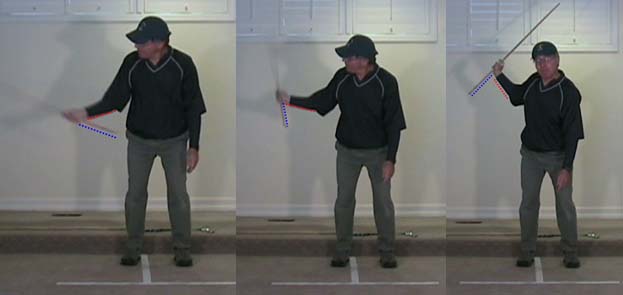
The right clap hand action is only the first part of my takeaway drill description. The second part involves practicing with a dowel stick - where I try to keep my right wrist level while performing the right clap hand action.


This series of photos shows that I am trying to keep the right wrist level (without any right wrist upcocking) while the right wrist bends back during the right clap hand action - note that I am looking-looking to ensure that the central end of the dowel stick (blue dotted line) remains in-line with the right forearm (red dotted line). That should hopefully help keep the clubshaft on-plane during the entire backswing action.

Augusta - do you have a different right forearm takeaway recommendation for a swinger versus a hitter? I thought that the right forearm takeaway fanning action is similar, except that a swinger allows the left forearm to pronate more thus producing the start up swivel action that gets the toe of the club up by the end of the takeaway, while a hitter simply carries the hands back during the right forearm takeaway with no left forearm pronatory-induced swivel action.

Jeff.
<>

Jeff~ Does this result in the blue end of the dowel pointing at the plane line?

DRW
Originally Posted by Jeff
I favor the "right forearm takeaway" move that I learnt about here. However, there are different ways of teaching/conceptualising that movement. I noted that VJ Trolio in Yoda's Alignment Golf DVD talked about making a lawnmower move. However, I think that it predisposes to a push action elbow position, rather than ensuring the "correct" fanning motion of the right forearm.
Neither V.J. nor I teach the Right Forearm Takeaway as a 'lawnmower pull'. That move has been well-publicized over the past few years by Jim Hardy in his 'One Plane / Two Plane' books and DVDs. Jim had just presented a two-day PGA educational seminar at V.J.'s home club, Old Waverly Golf Club, in West Point, Mississippi. V.J.'s one-sentence comment on our DVD -- delivered with a big smile and demo -- was a stream-of-consciousness reference to Jim's presentation.

Now you know . . .

The rest of the story.

Originally Posted by Jeff


Image 3/4 shows how far the right hand can go back if I allow my upper and lower torso to rotate freely (to about a 45 degrees pelvic rotation and a 80-90 degrees shoulder rotation) while performing the right hand clapping action. Note that the right hand ends up behind the right shoulder with the right forearm vertical to the ground. If a golfer has the flexibility to get to that position, then he should be in the perfect end-backswing position (for a swinger).

What do you think of my "method" of executing/teaching a takeaway action?
Jeff,

At the Top, your right palm is facing outward, as if you were a traffic cop saying "Stop!" As a golfer, do you think this is the proper alignment of the palm to the Inclined Plane? How will this affect your Left Wrist? How will your Clubface and Clubshaft be aligned should the palm actually achieve this alignment?

Yoda - I agree about the lawnmower drill. You very quickly interrupted VJ Trolio when he talked about the lawnmower pull action in your DVD lesson - because you appropriately didn't want him to demonstrate a push action elbow positioning movement. You wanted him to demonstrate a right forearm fanning action.

Regarding my right palm position in the right hand clap action motion - that is not what one desires in a golf backswing action. I was simply demonstrating how the right elbow/forearm should fold/fan when one performs a right clap hand action - and that biomechanical action occurs naturally/automatically at the level of the right shoulder (as external rotation of the right humerus).

The next step in the learning process is the realization that when the right wrist bends back during the right clap hand action, that the right wrist should remain level - with no upcocking action at the level of the right wrist. That should allow the right palm to become parallel to the inclined plane (turned shoulder plane) at the top of the swing (and not facing away from the target) - as you demonstrated with the two raquets in your DVD lesson. I paid very careful attention to your DVD lesson instructional insights when I viewed the DVD - I was not completely asleep when I viewed, and reviewed, your excellent DVD lesson. I recognize a good lesson when I see one!

DRW - when practicing with a dowel stick, as per Yoda's DVD-instruction, one should look at the central end of the dowel stick to check its level alignment relative to the right forearm - to ensure that the right wrist remains level during the right clap hand action. However, one should also be checking that the end of the dowel stick that is nearest the ground always points at the base of the inclined plane - to ensure that the clubshaft is always on-plane (except when the dowel stick is parallel to the base of the inclined plane). In that sense, a practice-lesson with a dowel stick serves two useful functions. I can readily understand why Yoda likes his dowelsss!

Jeff.
Yes. Fanning and bending like a hand clap. The RFT is a great and consistent way of taking the club away. I used to push things away with my shoulders and left arm, rocking the triangle. It caused all sorts of problems for me. RFT pulls the rest along in a reliable , consistent and perfectly aligned manner. The right arm pulls the left , the left arm pulls the left shoulder the perfect amount. Remember the distinction between upper and lower body as in the McDonald drills however. The right hip goes back and the right arm goes up.

With extensor action, a frozen right wrist and a cleared right hip the RFT alone seems to accomplish most everything for me on the backswing. Maybe Id add hinge action to the list here and alignments, flashlights etc.

The only thing Id add about your photos is that with your left arm off the club and therefor no check rein action you are obviously not employing extensor action here. Need to turn that extensor action on when both arms are attached for the full benefit of the RFT: Extension, the right elbow cocking the left wrist etc.

Its gets so simple, so easy to repeat. Like you are just taking that frozen right wrist to top.

OB
IF you stood inside Homer's plastic plane board would the right forearm lay on the plane as it goes up and and down?
Originally Posted by mb6606 IF you stood inside Homer's plastic plane board would the right forearm lay on the plane as it goes up and and down?
MB

Id love to stand in a plane board and observe things like this. Homer said something to the affect that we would all be surprised by our findings.

Id say that now that I am hitting I seem to feel or perceive my RFFW being on plane longer. Maybe this is angled hinging, I dunno. For sure the RFFW feels more intact throughout now. To answer your question more directly Id say that it is on plane through impact or after the release swivel.

Is this right guys?

OB
Originally Posted by Yoda Jeff,

At the Top, your right palm is facing outward, as if you were a traffic cop saying "Stop!" As a golfer, do you think this is the proper alignment of the palm to the Inclined Plane? How will this affect your Left Wrist? How will your Clubface and Clubshaft be aligned should the palm actually achieve this alignment?

Precisely boss . .. a ROLLED right forearm at Top = clubshaft shoots across the line.
Jeff - I agree the clap position is a great way to learn the RFT, but only if combined with learning the startup swivel, hence why there are 2 EdZ drills!

The level right wrist being a huge part of understanding how the swivel and the clap blend.

Yoda - would agree that besides the turn\swivel, the clap move does show how the right arm moves?

Jeff - the other big key in my view, at least for a swingers RFT is that the elbows stay the same distance apart and point down. This helps ensure the turn is on plane during RFT, and that the loading action on PP#3 is rotated "on line". (wheel rim)

For hitter's, the key is the paddle wheel (wheel track) feel of your photos.
Originally Posted by Jeff


If a golfer has the flexibility to get to that position, then he should be in the perfect end-backswing position (for a swinger).

What do you think of my "method" of executing/teaching a takeaway action?
For the correct Right Wrist alignment at the Top, see my friend Mike Bender's alignment here:

http://www.pga.com/summit/2008/news/summit120708.html

In this unique hands-apart, no-club demonstration, note the right palm 'up' (to the Plane) and the complementary left palm 'down'.

Or, go here for a photo taken during my 'comeback' school almost five years ago at the PGA TOUR Academy in St. Augustine, Florida:

http://lynnblakegolf.com/cmps_index.php?page=academy

The young man on my left was (and is) one of the staff professionals. As you can see from his racquet's closed position, he didn't quite get it at first. But he soon did, and in the last couple of years has penned several authoritative articles for a major golf magazine.

That's what Alignment Golf, competent teaching and 'passing the torch' is all about.

Yoda - I agree 100% with your position.

As I stated in another post, I am writing a review paper for my personal website and that composite photograph of capture images from a swing video is used to demonstrate only the first learning action - learning to execute a right clap hand motion, which only trains a golfer to understand how the right forearm and right elbow should move in the backswing (and not the right wrist). The second learning action re: the right upper limb requires learning how to bend the right wrist without allowing the right wrist to upcock - while performing the right clap hand action. That allows the right palm (and clubshaft) to remain on-plane during the backswing.

I am demonstrating that point here.


Stuart Appleby is doing a better job of demonstrating that action here.


Jeff.