It is my understanding that the clubshaft should always remain on-plane when it is swinging through the impact zone (which I will loosely describe as being between the third parallel and fourth parallel) and I am under the impression that this rule applies equally to swingers versus hitters.
The orbit that the clubhead will transcribe during its passage through the impact zone will be circular, and the size of the circular orbit must be related to the angle of the inclined plane - being smaller for a shallower inclined plane (eg. elbow plane), and larger for a steeper inclined plane (turned shoulder plane). The hands will also move inside more quickly if the circular orbit is smaller - eg. Hogan's swing where his clubshaft is slightly below the elbow plane (closer to the hand plane) during its passage through the impact zone - and that it is not dependent on whether a golfer is a swinger or a hitter.
Do you agree, or disagree?
Jeff.
Jeff. I am confused. When you say "the clubhead will transcribe during its passage through the impact zone will be circular" what is your vantage point?
jeez, all this so you can go back to ISG and shout "you're wrong" at people.

Toolish
I presume that we agree that the clubhead never travels in a straight line and that its path is always circular.
Here is a tracing of Kevin Na's clubhead arc through the impact zone.
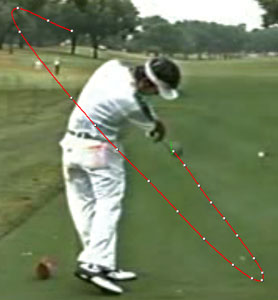
Although the clubhead arc is circular as the golfer traces a SPL, the clubshaft lies against the surface of the inclined plane as it travels through the impact zone - as seen from a DTL view. In that sense, the clubshaft must stay on-plane against the surface of the
selected inclined plane (eg. elbow plane) during its passage through the impact zone.
Jeff.
Originally Posted by GPStyles
jeez, all this so you can go back to ISG and shout "you're wrong" at people.
Styles- you are wrong. I have been barred from posting at ISG.
This "Golf for Jeff" forum allows any LBG forum member to post their opinions regarding golf mechanics/biomechanics/geometry/physics without fear of censorship - in contrast to ISG which doesn't allow contrary
minority opinions that are unpopular. I will only censor comments that are overt ad hominem attacks. There will no flame wars in this forum as long as I am moderator. You, or any other LBG member, are fully entitled to prove me (or another forum member) wrong on any golf swing issue as long as the post doesn't contain unnecessary ad hominem insults. In fact, very vigorous debate is highly encouraged in this forum as long as the poster doesn't indulge in non-decorous behavior that degrades the "quality" of this LBG forum.
Jeff.
Originally Posted by Jeff
It is my understanding that the clubshaft should always remain on-plane when it is swinging through the impact zone (which I will loosely describe as being between the third parallel and fourth parallel) and I am under the impression that this rule applies equally to swingers versus hitters.
The orbit that the clubhead will transcribe during its passage through the impact zone will be circular, and the size of the circular orbit must be related to the angle of the inclined plane - being smaller for a shallower inclined plane (eg. elbow plane), and larger for a steeper inclined plane (turned shoulder plane). The hands will also move inside more quickly if the circular orbit is smaller - eg. Hogan's swing where his clubshaft is slightly below the elbow plane (closer to the hand plane) during its passage through the impact zone - and that it is not dependent on whether a golfer is a swinger or a hitter.
Do you agree, or disagree?
Jeff.
I have to disagree. I would say it almost exactly opposite.
The Clubshaft should never remain on-plane when it is swinging through Impact. If the Clubshaft stayed on Plane, it would result in a shank. The club has a CG or CM, which is an imaginary line that extends from Sweet Spot through the #3 pressure point.
2-F
Regardless of where the Clubshaft and Clubhead are joined together, it always feels as if they are joined at the Sweet Spot - the longitudinal center of gravity, the line of the pull of Centrifugal Force. So there is a Clubshaft Plane and a Sweet Spot, or Swing, Plane. But herein, unless otherwise noted, Plane Angle and Plane Line always refer to the Center of Gravity application. Study 2-N. Except during Impact, the Clubshaft can travel on, or to- and - from, either Plane because the Clubshaft rotation must be around the Sweet Spot - not vice versa. So Clubhead Feel is Clubhead Lag Pressure (6-C) and is a Golfing Imperative. (2-0). If Lag Pressure is lost the Hands tend to start the hosel (instead of the Sweet Spot) toward Impact - that mysterious Shank. When in doubt, Turn the Clubface so both the Clubshaft and Sweet Spot will be on the same plane at Start Down. Both Planes always pass through the Lag Pressure Point. Study 6-C-2-A.
YodasLuke
I think that the difference between the clubshaft line and the imaginary straight line between PP#3 and the sweetspot is comparatively very small, and I am happy to reword my question to fit your requirement "that the sweetspot plane should be constant through the impact zone". The only point that I am attempting to make is that a golfer should continuously trace a SPL through the impact zone - and that includes the post-impact period - and that the resultant hand arc shape will depend on the angle of the inclined plane.
Jeff.
The hand arc will also depend on release type, no?
Toolish
It is not clear to me why you would think that the hand arc path near impact and post-impact would depend on release type.
My main interest, in posing this question, is whether the hand arc post-impact is relatively "fixed" for a good golfer who stays on-plane - because his hands have to move along an overall arc that depends on the angle of his selected inclined plane through the impact zone and the "fact" that he needs to continuously trace a SPL while his hands move through the impact zone.
Jeff.
Originally Posted by Jeff
YodasLuke
I think that the difference between the clubshaft line and the imaginary straight line between PP#3 and the sweetspot is comparatively very small, and I am happy to reword my question to fit your requirement "that the sweetspot plane should be constant through the impact zone".
I know the difference seems small, but the difference between a shank and perfection could be millimeters. So, I appreciate the rewording. I'm sure you understand that small differences can lead to a future reader's misunderstanding, when using words like "always".
Originally Posted by Jeff
The only point that I am attempting to make is that a golfer should continuously trace a SPL through the impact zone...
Jeff.
I agree.
Yodas Luke
I agree with you - being exact is important. I appreciate your "corrective" comments. That's what's so nice about LBG-website's different forums - many forum members think deeply about the golf swing in an attempt to understand it "correctly" and understanding it "correctly" requires paying strict attention to all the complex details.
It would have been much better if I used the word "hand" instead of "clubshaft" in my title, because I was really interesting in addressing the issue of movement of the hands post-impact.
Jeff.
ISG readers just got sick of the "he said you said" where it was not appropriate to the majority of those reading in that forum. So Jeff was asked nicely to take his ball elsewhere. He did not, so now he is indeed barred. Sadly the cheers were loud.
Originally Posted by golfguru
ISG readers just got sick of the "he said you said" where it was not appropriate to the majority of those reading in that forum. So Jeff was asked nicely to take his ball elsewhere. He did not, so now he is indeed barred. Sadly the cheers were loud.
The cheers were only from the sheep following the drivel written by the cowboy with zero 2nd tilt claiming he got Hogan's move...Seriously Jeff stuff is worth the read
Jeff, keep on going.....
There are clubshaft, center of mass for the club-COM and sweetspot. Under centrifugal acceleration, from what I gather so far, I think the grip-end of the clubshaft points to the COM and the line linking them lies in a plane. Shouldn't this be the optimal condition ... least swing effort? I also believe now that at impact, the sweetspot on the clubhead lies in front of the COM. Is it on the same orbit as the COM? Should it be in the same orbit in a well-designed golf club?
Originally Posted by chbkk
from what I gather so far, I think the grip-end of the clubshaft points to the COM and the line linking them lies in a plane. Shouldn't this be the optimal condition ... least swing effort?
I added the red, but to be more specific, I would say "the CG runs through the #3 Pressure Point."
Originally Posted by YodasLuke
I have to disagree. I would say it almost exactly opposite. The Clubshaft should never remain on-plane when it is swinging through Impact. If the Clubshaft stayed on Plane, it would result in a shank. The club has a CG or CM, which is an imaginary line that extends from Sweet Spot through the #3 pressure point.
2-F
Regardless of where the Clubshaft and Clubhead are joined together, it always feels as if they are joined at the Sweet Spot - the longitudinal center of gravity, the line of the pull of Centrifugal Force. So there is a Clubshaft Plane and a Sweet Spot, or Swing, Plane. But herein, unless otherwise noted, Plane Angle and Plane Line always refer to the Center of Gravity application. Study 2-N. Except during Impact, the Clubshaft can travel on, or to- and - from, either Plane because the Clubshaft rotation must be around the Sweet Spot - not vice versa. So Clubhead Feel is Clubhead Lag Pressure (6-C) and is a Golfing Imperative. (2-0). If Lag Pressure is lost the Hands tend to start the hosel (instead of the Sweet Spot) toward Impact - that mysterious Shank. When in doubt, Turn the Clubface so both the Clubshaft and Sweet Spot will be on the same plane at Start Down. Both Planes always pass through the Lag Pressure Point. Study 6-C-2-A.
guyz, what does the last part mean? about the when in doubt, turn the clubface so both the shaft and sweet spot on same plane at start down? how dos that stop a shank? how do you feel it happening? is it a fanning of the face? what is turn the clubface?
thanks
(ok i admit, i shanked a few last outing...need help!!!

Jeff....
Hold a golf club between the tips of your fingers at the end of the grip so the club dangles vertically. Now twist it in your fingers, note how the shaft moves around the COG of the club, not the head moving around the hosel.
A robot with fully flexible wrist joints won't know where the shaft is...it will know where it (the robot) mounts to (grips) the club, and where the COG is. As the club is swung then the plane through the COG will be what the robot can "sense" as centrifugal force will not be pulling down the shaft, but rather through the COG.
I have not read the entire article,nor will I,no disrespect to anyone,just lazy lol.
But please tell me the big club in vid is swingers action,not hitter.thanks
Originally Posted by brownman
I have not read the entire article,nor will I,no disrespect to anyone,just lazy lol.
But please tell me the big club in vid is swingers action,not hitter.thanks
By design, it is definitely a Swing (with its Horizontal Hinging). When
Ted emailed the clip over, he even added this P.S.:
"It's not a bad Swing for a Hitter!"

Thanks Yoda for that,(wiping sweat from brow),to see Ted doing this with Hitters pattern would in my eyes be a gem (big club) I would pin that up beside hitting stickman,that would clear the fog for many a hitters learning process.
Thanks again
Originally Posted by brownman
Thanks Yoda for that,(wiping sweat from brow),to see Ted doing this with Hitters pattern would in my eyes be a gem (big club) I would pin that up beside hitting stickman,that would clear the fog for many a hitters learning process.
. . . it must be supplied.
Ted!
Call to arms!
http://www.15thnewyorkcavalry.org/Media/cal2arms.wav
Assembly!
http://www.15thnewyorkcavalry.org/Media/assembly.wav
Charge!
http://www.15thnewyorkcavalry.org/Media/charge.wav

Originally Posted by Yoda
. . . it must be supplied.
Ted!
Call to arms!
http://www.15thnewyorkcavalry.org/Media/cal2arms.wav
Assembly!
http://www.15thnewyorkcavalry.org/Media/assembly.wav
Charge!
http://www.15thnewyorkcavalry.org/Media/charge.wav
I'm wiping the tears from my eyes!
Nice job!
Thanks for the music links Yoda, at last I know what's happening in those John Wayne Westerns!
I'd agree that "swing " looks really good. Ted when do you get a set of these from Henry Griffitts?
Sorting Through the Golf Nut's Catalog.
B-Ray
Yoda
I think that Yodas Luke does have a very symmetrical swing overall.
However, according to Homer's theory, doesn't the inclined plane have to be the sweetspot plane? If correct, then if a golfer is swinging on that sweetspot plane, then i) the hosel should be rotating towards that sweetspot plane during the takeaway swivel action, and ii) the hosel should be rotating away from that sweetspot plane during the release swivel phase (from the 3rd parallel to impact), and then iii) the hosel should rotate back towards the sweetspot plane during the followthrough phase (from impact to the 4th parallel).
However, in Yodas Luke's demonstration, the hosel was staying on the elbow plane during i) and ii), which fits in with my theory. Surely, the hosel cannot only rotate away/to from the sweetspot plane at one swing phase-point - point iii) - and not at the other two swing phase-points, if the hosel was operating in accordance with Homer's theory?
Jeff.
Originally Posted by Jeff
Yoda
I think that Yodas Luke does have a very symmetrical swing overall.
However, according to Homer's theory, doesn't the inclined plane have to be the sweetspot plane? If correct, then if a golfer is swinging on that sweetspot plane, then i) the hosel should be rotating towards that sweetspot plane during the takeaway swivel action, and ii) the hosel should be rotating away from that sweetspot plane during the release swivel phase (from the 3rd parallel to impact), and then iii) the hosel should rotate back towards the sweetspot plane during the followthrough phase (from impact to the 4th parallel).
However, in Yodas Luke's demonstration, the hosel was staying on the elbow plane during i) and ii), which fits in with my theory. Surely, the hosel cannot only rotate away/to from the sweetspot plane at one swing phase-point - point iii) - and not at the other two swing phase-points, if the hosel was operating in accordance with Homer's theory?
Jeff.
Jeff,
You don't swing the
hosel.
You swing the
Clubhead. More specifically, the Clubhead's
Sweetspot.
Period.
Stop wasting everybody's time. Your talents are better applied elsewhere.
Give this one a rest.

Originally Posted by Yoda
Jeff,
You don't swing the hosel.
You swing the Clubhead. More specifically, the Clubhead's Sweetspot.
Period.
Stop wasting everybody's time. Your talents are better applied elsewhere.
Give this one a rest.
I'd like to second that.
How can such an intelligent man have so much trouble understanding the many, at times all most spoon fed, explanations of things on the other side of HIS debate points? An intentional deaf ear perhaps?
Jeff I actually like your debates but enough is enough. The juice from this fruit is long since gone.
Respectfully
OB
OB left
The concept of "who" is tilting at windmills is a personal opinion.
Telling a person that he must not express his opinion because "enough is enough" is equivalent to censorship.
I don't censor anybody in this forum as long as they express their opinions decorously in their post. I expect to be treated in a like manner.
I agree with Yoda when he states that a golfer swings the clubhead. I will even partially accept the idea that he specifically swings the sweetspot of the clubhead. However, where I differ from the majority viewpoint is that I believe that a golfer must swing the clubhead along the clubshaft plane, and not sweetspot plane 2, in order to get the sole of the club to be parallel to the ground, and along the surface of the ground, at impact. Yodas Luke's demonstration with a big club provides experimental proof that supports my belief.
In the backswing, he took his clubshaft up the clubshaft plane (not sweetspot plane 2) and during the downswing he took his clubshaft down the clubshaft plane (and not the sweetspot 2 plane). From its address position on the sweetspot plane to its end-backswing position on the clubshaft plane, the sweetspot rotated away from sweetspot plane 2 to get to the clubshaft plane by the end of his backswing. From the delivery position to impact, the sweetspot rotated away from the clubshaft plane to get to the sweetspot plane 2 by impact.
This exactly what I predicted when I wrote in post #165 that a golfer would always have to swing his clubshaft along the clubshaft plane, but he would have to make an accomodation for a greater hosel-sweetspot distance not by altering his on-plane swing (as he would perform it with a clubshaft that lacked a clubhead), but by simply standing the appropriate distance away from the ball.
In other words, I believe that the experimental evidence from Yodas Luke's demonstration swing with a big club supports my belief that the sweetspot rotates away from, and to, the clubshaft plane - and that the hosel doesn't rotate away from, and to, the sweetspot plane.
You are free to disagree with me, and harbor a contrary belief, but you have no "right" to attempt to censor my opinion (by stating "enough is enough") because my opinion conflicts with your opinion.
Jeff.
Jeff
I now feel that winning you over from the dark side is my challenge. Unless Yoda kicks both of us out of his forum before long..
Please consider my response. Your statements are in quotations, each followed by my opinion or question.
"I agree with Yoda when he states that a golfer swings the clubhead."
What do you exactly mean by "swings the clubhead"?
"I will even partially accept the idea that he specifically swings the sweetspot of the clubhead."
My own statement would be to swing the clubhead and to keep the COM of the clubhead on a plane.
"However, where I differ from the majority viewpoint is that I believe that a golfer must swing the clubhead along the clubshaft plane, and not sweetspot plane 2, in order to get the sole of the club to be parallel to the ground, and along the surface of the ground, at impact."
1) So in your mental image, the clubshaft plane is the plane board and by swing the clubhead along the clubshaft plane, you mean to have the clubhead including the hosel touch the plane board at all time regardless of the clubhead orientation? Then the clubhead rotation must now be restricted to the rotation around the hosel with its COM moving in and out of the plane board which I find hard to accept.
2) “Swinging clubhead along the clubshaft plane” is not the necessary and sufficient condition to get the sole of the club to be parallel to the ground and along the surface of the ground at impact.
You can see from the example in my post #154 Experiment 2, that we can setup the swing machine to swing the COM of the clubhead along the pp#2 to COM axis and still get the sole of the club to be parallel to the ground and along the surface of the ground at impact.
"Yodas Luke's demonstration with a big club provides experimental proof that supports my belief."
Not at all! Quite the contrary in my opinion.
"In the backswing, he took his clubshaft up the clubshaft plane (not sweetspot plane 2)"
OK, there is a plane shift from backswing to the downswing probably exaggerated by the parallax effect. Yodasluke is not a robot. Or is he? His swing is the most precised I have observe of any human. The backswing stage is of low energy and it does not matter much that you need to keep the sweetspot on plane during a backswing. But he sure keeps the sweetspot on plane during the downswing.
"... and during the downswing he took his clubshaft down the clubshaft plane (and not the sweetspot 2 plane)."
Jeff. Either you need a new pair of glasses or we need to agree on some common terms and definitions. Can you illustrate your statement here in the images?
"From its address position on the sweetspot plane to its end-backswing position on the clubshaft plane, the sweetspot rotated away from sweetspot plane 2 to get to the clubshaft plane by the end of his backswing. From the delivery position to impact, the sweetspot rotated away from the clubshaft plane to get to the sweetspot plane 2 by impact."
I see the hosel dragging the clubhead and the sweetspot down along the sweetspot plane until the swivel moves the hosel away from the sweetspot plane and squares up the clubface for impact. Meanwhile, the sweetspot stays very precisely on plane.
"This exactly what I predicted when I wrote in post #165 that a golfer would always have to swing his clubshaft along the clubshaft plane, but he would have to make an accomodation for a greater hosel-sweetspot distance not by altering his on-plane swing (as he would perform it with a clubshaft that lacked a clubhead), but by simply standing the appropriate distance away from the ball"
Any golf club must have a clubhead.
The dowel that you swing should represent the line segment from pp#2 to the COM of the clubhead, not the clubshaft.
The flashlight that you use to trace the SPL should represent this line segment too, not the clubshaft.
A golfer must prepare his posture and his muscles differently for different hosel-sweetspot distance to centripetal-pull along this line segment with varying direction from different location of the COM of the clubhead. Can you please explain, as an expert in human anatomy, how one must have different posture for different direction of pull?
"In other words, I believe that the experimental evidence from Yodas Luke's demonstration swing with a big club supports my belief that the sweetspot rotates away from, and to, the clubshaft plane - and that the hosel doesn't rotate away from, and to, the sweetspot plane"
A big NO, Jeff. We still have major disagreement.
Originally Posted by Jeff
You are free to disagree with me, and harbor a contrary belief, but you have no "right" to attempt to censor my opinion (by stating "enough is enough") because my opinion conflicts with your opinion.
Jeff,
I know you directed your post at
O.B. Left, but he was only seconding the headline in my own post; namely,
So Stop Already. You didn't confront me with the issue, but you did with him. Hence, this post and more time wasted for me.
My objective is not to censure your opinion. My objective is to deliver value to our readers. You've pecked on this now not-so-shiny hubcap long enough. You've been told that the only bird there is you. And yet you continue to peck.
This ain't a democracy, Jeff. It is a benevolent dictatorship. And you've just about drained my benevolence reservoir dry.
As landlord and bill-payer around here, I have neither the right nor the desire to censor your opinion. I
do have the right to evict you from this building, and I
will if you persist in this anti-TGM (and hence anti-LBG) behavior.
Heed my warning, Jeff, or you'll be pecking to your heart's content on your own site. Then perhaps you'll be able to answer the age-old question:
"If a tree falls in the forest when no one's around to hear, does it make a sound?"

Originally Posted by Jeff
It is my understanding that the clubshaft should always remain on-plane when it is swinging through the impact zone (which I will loosely describe as being between the third parallel and fourth parallel) and I am under the impression that this rule applies equally to swingers versus hitters.
The orbit that the clubhead will transcribe during its passage through the impact zone will be circular, and the size of the circular orbit must be related to the angle of the inclined plane - being smaller for a shallower inclined plane (eg. elbow plane), and larger for a steeper inclined plane (turned shoulder plane). The hands will also move inside more quickly if the circular orbit is smaller - eg. Hogan's swing where his clubshaft is slightly below the elbow plane (closer to the hand plane) during its passage through the impact zone - and that it is not dependent on whether a golfer is a swinger or a hitter.
Do you agree, or disagree?
Jeff.
Jeff
Its just that sometimes I think it is debate not golf that is your real sport.
When in your first post above you asked "Do you agree, or disagree?" Im thinking you would have gladly debated either side of a persons answer.
This is all very educational for you and some of the readers, my self included, but only to a point. Like I said I like these threads.
But we are still dealing with your first sentence above!
As for censorship, I only appeal for brevity in light of the fact these debates have no proper structure or moderator. Even Kennedy Nixon went off the air at one point. Was that censorship too?
Debates do end, normally. Although Im sure some parties could go on and on if given the chance.
Lets do 1-L-16 next. Thats a good one. Seriously, no joke. Id like it. Was Jack wrong in regard to how to hit a fade? Face angle or club head path as the determining factor in initial ball flight.
ob