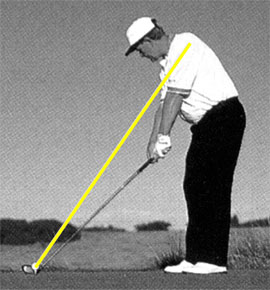
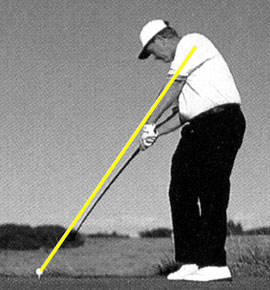
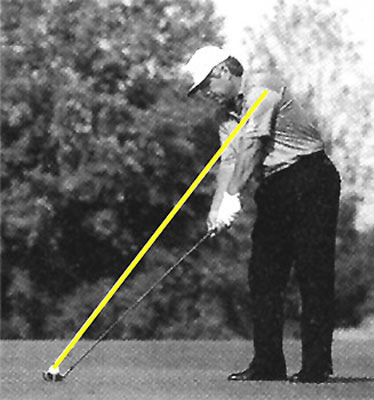
impact on TSP

I'm wondering about some pros and cons to the downswing being on the TSP.. including impact. Are there any specific components or accumulator sequences that would be necessary?

not sure where this can go but a little discussion on it might trigger a few questions. thanks
Originally Posted by slicer mcgolf I'm wondering about some pros and cons to the downswing being on the TSP.. including impact. Are there any specific components or accumulator sequences that would be necessary?

not sure where this can go but a little discussion on it might trigger a few questions. thanks
To start, the simplest procedure would be the standard shoulder turn (10-13-A) which is really a combination of B-Flat backstroke and D-On Plane downstroke.

Not mandatory, but recommended.

7-13 SHOULDER TURN
...
When the Shoulder moves on the same Downstroke Plane as the Hands it provides the greatest support and its best guidance to the Stroke.
...

10-13-A STANDARD
This is dual application of the Flat (-B below) Backstroke and On Plane (-D below) Down-stroke Shoulder Turn.

10-13-B FLAT
This is a relatively flat Backstroke Shoulder Turn which places the Shoulder “On Plane” for any Plane Angle with a flatter angle than the Rotated Shoulder Angle. A Flat Down-stroke Shoulder Turn can serve only to impact a circular motion to the Stroke, but almost irresistibly “Off Plane.”

10-13-D ON PLANE
After a 13-B or 13-C Backstroke Shoulder Turn, the Right Shoulder moves toward Impact precisely on the preselected Down-stroke Clubshaft Plane, establishing and supporting the Power Package Delivery alignments. When the Shoulder can’t quite reach the Plane, it is better to use a steeper Plane.
Kevin
Originally Posted by KevCarter To start, the simplest procedure would be the standard shoulder turn (10-13-A) which is really a combination of B-Flat backstroke and D-On Plane downstroke.

Not mandatory, but recommended.


Kevin
Thanks Kev, great answer.

If I understand this correctly, the shoulder turn is a flatter one in which the right shoulder traces the tsp into impact.

I'm confused on what is bold.


10-13-B FLAT
This is a relatively flat Backstroke Shoulder Turn which places the Shoulder “On Plane” for any Plane Angle with a flatter angle than the Rotated Shoulder Angle. A Flat Down-stroke Shoulder Turn can serve only to impact a circular motion to the Stroke, but almost irresistibly “Off Plane.”

10-13-D ON PLANE
After a 13-B or 13-C Backstroke Shoulder Turn, the Right Shoulder moves toward Impact precisely on the preselected Down-stroke Clubshaft Plane, establishing and supporting the Power Package Delivery alignments. When the Shoulder can’t quite reach the Plane, it is better to use a steeper Plane.
Originally Posted by slicer mcgolf Thanks Kev, great answer.

If I understand this correctly, the shoulder turn is a flatter one in which the right shoulder traces the tsp into impact.

I'm confused on what is bold.


10-13-B FLAT
This is a relatively flat Backstroke Shoulder Turn which places the Shoulder “On Plane” for any Plane Angle with a flatter angle than the Rotated Shoulder Angle. A Flat Down-stroke Shoulder Turn can serve only to impact a circular motion to the Stroke, but almost irresistibly “Off Plane.”

10-13-D ON PLANE
After a 13-B or 13-C Backstroke Shoulder Turn, the Right Shoulder moves toward Impact precisely on the preselected Down-stroke Clubshaft Plane, establishing and supporting the Power Package Delivery alignments. When the Shoulder can’t quite reach the Plane, it is better to use a steeper Plane.
I think that is an endorsment by Mr. Kelley for using the TSP. I believe what he meant is that he feels a straight line delivery to the aiming point is the simplest procedure, and you can't do it from the elbow plane. Hence, better to use the steeper TSP where the right shoulder can travel down the plane line.

I think Bucket is correct, as always, the elbow plane procedure includes a lot more #3, possibly why folks like Mr. Gay aren't super long, but perhaps also why Brian is so solid and consistent.

My opinion is the TSP with straight line delivery in a hitting procedure is incredibly easy to master.

I could be completely wrong...

There are lots of great ways to get 'er done, but TSP is what I am loving right now. No disrespect to Mr. Bucket.

Kevin
Thanks again Kev,

Why do you think that using more #3 doesn't result in distance? I know what #2 and #3 are but I think I'm confused as to their usage with a tsp straight line delivery.
Originally Posted by KevCarter No disrespect to Mr. Bucket.

Kevin
Kev, I've isolated the section of your post that was disturbing and off-base. Please - how many times do we need to go over this before you get it! Let's not see this kind of thing again
Originally Posted by Mike O Kev, I've isolated the section of your post that was disturbing and off-base. Please - how many times do we need to go over this before you get it! Let's not see this kind of thing again


Sorry Mike, I lost my head for a minute!


Kevin
Originally Posted by slicer mcgolf Thanks Kev, great answer.

If I understand this correctly, the shoulder turn is a flatter one in which the right shoulder traces the tsp into impact.

I'm confused on what is bold.


10-13-B FLAT
This is a relatively flat Backstroke Shoulder Turn which places the Shoulder “On Plane” for any Plane Angle with a flatter angle than the Rotated Shoulder Angle. A Flat Down-stroke Shoulder Turn can serve only to impact a circular motion to the Stroke, but almost irresistibly “Off Plane.”

10-13-D ON PLANE
After a 13-B or 13-C Backstroke Shoulder Turn, the Right Shoulder moves toward Impact precisely on the preselected Down-stroke Clubshaft Plane, establishing and supporting the Power Package Delivery alignments. When the Shoulder can’t quite reach the Plane, it is better to use a steeper Plane.


Hey, can I get in on this party?

In regard to 10-13-B FLAT. I believe your bolded "almost always irresistibly Off Plane" is the Startdown's equivalent to the pure Shoulder Turn Takeaway in Startup and the basic problem there in. Namely, the shoulders are not (given a Flat Shoulder Turn in startdown) traveling on the Inclined Plane and therefore are likely to take the Hands or Power Package with them on their off plane meanderings.

Pivot Chain and Sequencing etc demand that the Shoulders and not the Arms provide the initial movement in Startdown for Total Motion shots and so its best to align the Shoulders to the Inclined Plane in Startdown. 10-13-D On Plane. (In Startdown)

All of this suggests that the shoulders dont ideally merely turn on the same plane back and down. Flat Back gets the Right Shoulder closer to Shaft Plane relatively speaking (compared to Rotated which would have a higher associated TSP angle) and then On Plane going down. Luke described this to me as the right shoulder painting a reverse "7" on the back wall of his hitting station. Notice how the top of the seven is flat and then a diagonal towards the ball. This portrays a TSP which is on the Shaft Plane I guess. Straight Line Delivery Path which requires Hip Action.

So the 10-13-B Flat going back lowers the Right Shoulder some and then given a Slide Hip Turn, Axis Tilt in transition (or before, see Hogan) the Right Shoulder is further lowered to a Turned Shoulder Plane that more closely approaches the Shaft Plane for it move 10-13-D On Plane. If this TSP actually matches the shaft plane, then no further plane angle shifting is required, if it only approaches the shaft plane then a shift or shifts (the more shifts the more you approach Circle Path) will be required. But its less of a shift than if you didnt use Axis Tilt.

At least that is what I make of 10-13-D's "better to use a steeper plane". If Im correct, which remains to be seen, it should probably read something like "When the Shoulder cant quite reach the Shaft Plane, its still better to use this TSP plane angle than a higher one".

You know when you try to rewrite Homer you quickly understand his preference for brevity. Consider the previous paragraph a Wiki guys.
Originally Posted by O.B.Left Hey, can I get in on this party?

In regard to 10-13-B FLAT. I believe your bolded "almost always irresistibly Off Plane" is the Startdown's equivalent to the pure Shoulder Turn Takeaway in Startup and the basic problem there in. Namely, the shoulders are not (given a Flat Shoulder Turn in startdown) traveling on the Inclined Plane and therefore are likely to take the Hands or Power Package with them on their off plane meanderings.

Pivot Chain and Sequencing etc demand that the Shoulders and not the Arms provide the initial movement in Startdown for Total Motion shots and so its best to align the Shoulders to the Inclined Plane in Startdown. 10-13-D On Plane. (In Startdown)

All of this suggests that the shoulders dont ideally merely turn on the same plane back and down. Flat Back gets the Right Shoulder closer to Shaft Plane relatively speaking (compared to Rotated which would have a higher associated TSP angle) and then On Plane going down. Luke described this to me as the right shoulder painting a reverse "7" on the back wall of his hitting station. Notice how the top of the seven is flat and then a diagonal towards the ball. This portrays a TSP which is on the Shaft Plane I guess. Straight Line Delivery Path which requires Hip Action.

So the 10-13-B Flat going back lowers the Right Shoulder some and then given a Slide Hip Turn, Axis Tilt in transition (or before, see Hogan) the Right Shoulder is further lowered to a Turned Shoulder Plane that more closely approaches the Shaft Plane for it move 10-13-D On Plane. If this TSP actually matches the shaft plane, then no further plane angle shifting is required, if it only approaches the shaft plane then a shift or shifts (the more shifts the more you approach Circle Path) will be required. But its less of a shift than if you didnt use Axis Tilt.

At least that is what I make of 10-13-D's "better to use a steeper plane". If Im correct, which remains to be seen, it should probably read something like "When the Shoulder cant quite reach the Shaft Plane, its still better to use this TSP plane angle than a higher one".

You know when you try to rewrite Homer you quickly understand his preference for brevity. Consider this last paragraph a Wiki guys.
Some wonderful G.O.L.F. in that post. Thanks OB!

Kevin
Originally Posted by slicer mcgolf I'm wondering about some pros and cons to the downswing being on the TSP.. including impact. Are there any specific components or accumulator sequences that would be necessary?

not sure where this can go but a little discussion on it might trigger a few questions. thanks
Got any pictures?

Interesting that Mr. Kelley seemed to be more of an Elbow Plane guy in the earlier editions than the later ones.

Pretty significant differences in the release motions of #2 and #3 for the different plane angles . . . in addition you can't discount "dynamic" plane angle shifting thru the ball.
Originally Posted by 12 piece bucket Got any pictures?

Interesting that Mr. Kelley seemed to be more of an Elbow Plane guy in the earlier editions than the later ones.

Pretty significant differences in the release motions of #2 and #3 for the different plane angles . . . in addition you can't discount "dynamic" plane angle shifting thru the ball.
Thanks Bucket,

I'm assuming that with the shaft on the tsp at impact, #3 will be fairly active. how does #2 become more or less involved?

What do you mean by dynamic plane angle shifting?
Originally Posted by slicer mcgolf Thanks Bucket,

I'm assuming that with the shaft on the tsp at impact, #3 will be fairly active. how does #2 become more or less involved?

What do you mean by dynamic plane angle shifting?

Actually I'd say the opposite of above . . . TSP (steeper plane) much more #2 dependent . . . where as the flatter planes are more #3 dependent . . .