Does a swinger have the right or left forearm on the same plane of the shaft at impact?
Sorry, about this question but I can't find the answer.

Originally Posted by jerry1967With the Club secured under the heel of the Left Hand and with a Level Left Wrist (that is, neither Cocked or Uncocked) -- Hitting or Swinging -- the Club can never be 'in line' with the Left Forearm until Full Extension (Left Wrist Uncocked / Perpendicular Motion). Therefore, until that point in the Stroke -- immediately past Impact -- it can never be 'in line' (Perpendicularly) with the Clubshaft.
Does a swinger have the right or left forearm on the same plane of the shaft at impact?
Sorry, about this question but I can't find the answer.

Originally Posted by Yoda With the Club secured under the heel of the Left Hand and with a Level Left Wrist (that is, neither Cocked or Uncocked) -- Hitting or Swinging -- the Club can never be 'in line' with the Left Forearm until Full Extension (Left Wrist Uncocked / Perpendicular Motion). Therefore, until that point in the Stroke -- immediately past Impact -- it can never be 'in line' (Perpendicularly) with the Clubshaft.Thank you Lynn.
The Right Forearm is another story. Here, with the Left Wrist Level and the Club held towards the 'cup' of the Right Hand (which covers the Left Hand Thumb), the Right Forearm is 'in line' with the Clubshaft. This in-line condition (the Right Forearm Flying Wedge) is held throughout the Stroke.
At Address, Release and Impact, the Right Elbow (and thus, the Forearm) is in the Inclined Plane of Motion of the Clubshaft (actually, the Plane of the orbiting Sweetspot). At other points, e.g., the Backstroke, Top, Start Down and Downstroke, the Right Forearm supports that Clubshaft/Sweetspot Plane. All while maintaining its original 'in-line condition' of the Right Forearm and Clubshaft.
All of which is more easily expertly demonstrated than expertly explained in text.
The ultimate solution is to come see me.
Or . . .
A Lynn Blake Certified Instructor.
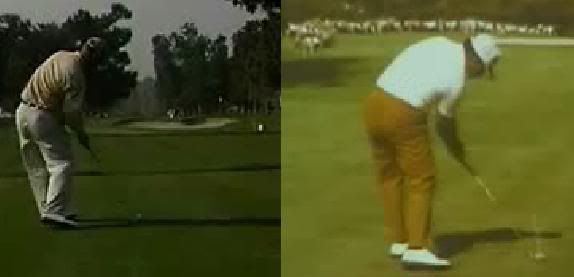
Originally Posted by gmbtempeBy definition, the Right Forearm Flying Wedge ("RFFW") always exhibits the Horizontal in-line condition of the Right Elbow, Forearm and Clubshaft (6-B-3-0-1). However, that does not mean that the RFFW always lies in the Inclined Plane of Motion of the orbiting Sweetspot. In other words, the elements of the RFFW -- Elbow, Forearm and Clubshaft -- lie in its own Plane, and this alignment may or may not be coincident with the Inclined Plane of the Golf Stroke.
If you were going to build the most mechanically sound stroke would you advocate getting the right forearm and shaft on the plane of the right forearm as soon as possible then just be able to rotate through the shot, I guess like Lee Trevino does?
Here is an impact photo for Duval and Trevino
