The Most Important Illustration in the History of Golf


A bold question, to be sure.

Any takers?

Ben Hogan's pane of glass?

(Can't find the picture from his book)

Originally Posted by airair Ben Hogan's pane of glass?

(Can't find the picture from his book)

There are so many great images in that book, too! The grip, the turning belt ahead of the arms....

But before Hogan, was Jones so...
Originally Posted by airair Ben Hogan's pane of glass?

(Can't find the picture from his book)

Hogan's 'plane of glass' Plane illustration is arguably the most famous illustration in golf. It is also among the most erroneous. Especially when combined with the three accompanying illustrations showing the 'baseline' shift to the right during the Downstroke.

My benchmark of "important" demands that the illustration also be correct.

Next?
Up until the one you just posted, I would have said Hogan at impact, specifically the close up of his left wrist.

but I like your post better because it gives the whole picture

Combine that with the 3 essentials, the 3 imperatives and the flying wedges and golf becomes easy to understand.

I'd throw in a supporting vote for 1-L
Originally Posted by Yoda Hogan's 'plane of glass' Plane illustration is arguably the most famous illustration in golf. It is also among the most erroneous. Especially when combined with the three accompanying illustrations showing the 'baseline' shift to the right during the Downstroke.

My benchmark of "important" demands that the illustration also be correct.

Next?

If the benchmark is that the illustration also be correct wouldn't that disqualify your pic. also as it doesn't include a real event of impact as no clubshaft will be in that position in a real swing at impact. They actually deflect the exact opposite way at that moment as the clubhead goes to a lead position from a lag position.

sasho mackenzie says:

"The final phase of shaft deflection was the most
important since it explained clubhead orientation at impact.
Over the final few hundredths of a second of the downswing,
the clubhead rapidly moved from its maximum
lagging position into its maximum leading position at
impact. The lead deflections at impact for the normal
optimized simulation were approximately 6.25 cm in
magnitude. The complete removal of radial force during
the downswing only reduced lead deflection to 4.72 cm
(Fig. 8; Table 1). Therefore, when acting in isolation, the
tangential forces that occur during the late phase (after
0.15 s) of the downswing were a major contributor to the
lead deflection at impact. The complete isolation of radial
force demonstrated that, while acting alone, radial force
only resulted in 1.22 cm of lead deflection at impact
(Fig. 9; Table 1)."

the full paper can be found at his website.
UofS Theses: Understanding the role of shaft stiffness in the golf swing
Originally Posted by wedgy If the benchmark is that the illustration also be correct wouldn't that disqualify your pic. also as it doesn't include a real event of impact as no clubshaft will be in that position in a real swing at impact. They actually deflect the exact opposite way at that moment as the clubhead goes to a lead position from a lag position.
Point taken, wedgy, but I stand by the point of the photo: the golfer should keep the ball and the head behind the hands.

Also, the stressed shafts could be taken to represent Clubhead Lag Pressure Point Pressure as felt in the #3 Pressure Point (right index finger). That is the way it feels.

Finally, my personal alignments are correct.


Originally Posted by Yoda Point taken, wedgy, but I stand by the point of the photo: the golfer should keep the ball and the head behind the hands.

Also, the stressed shafts could be taken to represent Clubhead Lag Pressure Point Pressure as felt in the #3 Pressure Point (right index finger). That is the way it feels.

Finally, my personal alignments are correct.


Yes i can understand that it is a good visual and feel to shoot for regardless if it( the shaft lag position at impact) happens or not. Never questioned your personal alignments as i'm more than sure they are correct for you.
Originally Posted by Bumpy Perhaps it is because I have embraced the 'Darkside' but my benchmark would be based on producing an effect for the intended audience. Regarding the pane of glass, .....Quit swinging across the ball. There are a bunch of, "if you try do this, god willing, you won't do that", directed specifically at the masses(they appear to have missed the idea completely). -example- I would say the aiming point procedure is designed to produce an effect. For the player at least, I would say practicallity takes precedents over reality. The instructor should know both, without it there can be no balance in 'the force'.

Da, dot, da da, dot, da da, dot, da da.......

With good intentions,
Bumpy

.........and yes, I already have a touch of cabin fever here in Michigan.


"No, I am Spartacus!"


I can't get the picture to come up but here is the link to it:

http://creativesagest.blogspot.com/


Here is another link to software that will allow you to overlay "Golden Ratio" sections over anything, say like a golf swing:

http://www.atrise.com/golden-section/


Remember all those black and white photos of a golfer going back and forth at high speed?


HK, as an engineering type, knew of this picture and "proportionalism" or what the Greeks called "analogia." I will assert that he knew and understood the order and balance of human design. I think HK knew the answer ("It all works together by design!" and reverse engineered how effective golf swingsbio-mechanically worked.

ICT
Originally Posted by innercityteacher "No, I am Spartacus!"


I can't get the picture to come up but here is the link to it:

http://creativesagest.blogspot.com/


Here is another link to software that will allow you to overlay "Golden Ratio" sections over anything, say like a golf swing:

http://www.atrise.com/golden-section/


Remember all those black and white photos of a golfer going back and forth at high speed?


HK, as an engineering type, knew of this picture and "proportionalism" or what the Greeks called "analogia." I will assert that he knew and understood the order and balance of human design. I think HK knew the answer ("It all works together by design!" and reverse engineered how effective golf swingsbio-mechanically worked.

ICT
I must admit to being oblivious to the practical application of the Golden ratio to my golfswing. In fact, my proportions are more akin to an apple, Golden Delicious seems more appropriate.

Bumpy
Originally Posted by Yoda


A bold question, to be sure.

Any takers?

New cover for my personal swing keys diary. I love it!!!

Kevin
Originally Posted by Yoda


A bold question, to be sure.

Any takers?

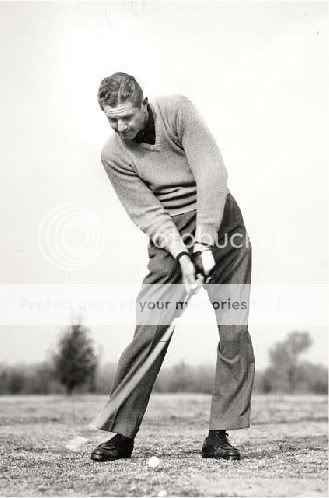
Lynn, what significance, if any, do you attach to the shaft bend seen here?

Its induced by contact with the ground but ....... prior to that contact, shaft bend of this nature , along this axis (aft/front of shaft), would be consistent with an increase in the rate of Radial Acceleration and have a corresponding and associated feel of increased Lag Pressure at the #3pp in its "first joint" location. (6-C-2-A THE ESSENCE, for you guys following along at home)

In this photo the #3 pp , the entire Longitudinal Center of Gravity (from #3pp to sweetspot) lags behind the shaft.

Thats what I see ........... apart from the Impact Hands Location, which didnt make 12-3 for some reason. And why didnt it?

I'd venture that it would be impossible to get this Impact Hands Location alignment seen here by "swinging the clubhead"....and so you must "swing the hands" and feel the Lag. Lag Pressure that is. Pressure. You're at Both Arms Straight and the club is still in the ground!
Coincidence? I doubt it.

[attachment unavailable]


Did Lynn ever elaborate on this? Did that orange ring kill Bucket? Where the heck is that guy?
Originally Posted by O.B.Left Coincidence? I doubt it.

[attachment unavailable]


Did Lynn ever elaborate on this? Did that orange ring kill Bucket? Where the heck is that guy?
Good catch OB. I hadn't noticed the significance of the logo before. I've got to get glasses, or YODA needs a bigger logo. That is FANTASTIC!

Kevin
Originally Posted by O.B.Left
Coincidence? I doubt it.

[attachment unavailable]
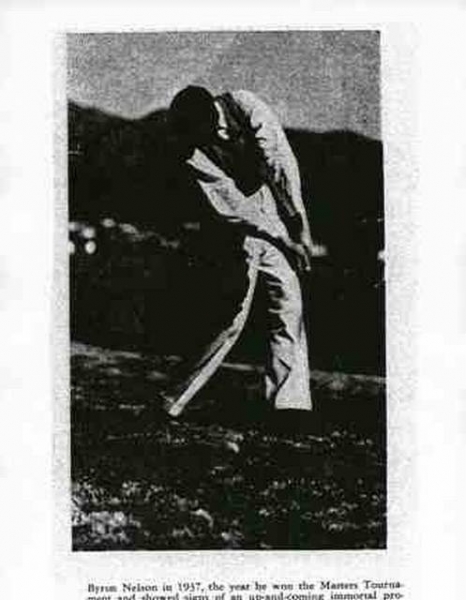
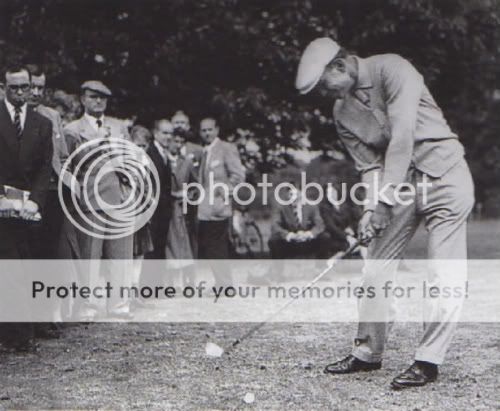
Byron Nelson, 1937, the year he first won The Masters.

Note:

(1) The Clubhead is a blur;

(2) The camera couldn't catch the Clubshaft; and

(3) The Ball is still on the ground.

Then . . .

Check out the Hands.


Ive marveled at that photo before but never noticed that the ball is still on the ground. Amazing.

Lynn I sense there's more to this ............will there be a time when we'll hear theeeeee rest of the story?
Originally Posted by Yoda Byron Nelson, 1937, the year he first won The Masters.

Note:

(1) The Clubhead is a blur;

(2) The camera couldn't catch the Clubshaft; and

(3) The Ball is still on the ground.

Then . . .

Check out the Hands.


Im thinking there is something to the fact that both Mr Nelson and Mr Blake have most of their bodies to the target side of their eye line to the ball prior to impact. All but from their right knee on down actually.

There's no way that is in the yellow book......or is it ?
Originally Posted by O.B.Left Coincidence? I doubt it.

[attachment unavailable]


Did Lynn ever elaborate on this? Did that orange ring kill Bucket? Where the heck is that guy?

Last seen at ABS.
Originally Posted by GPStyles Last seen at ABS.
There are a thousand ways to hit a Golf Ball.
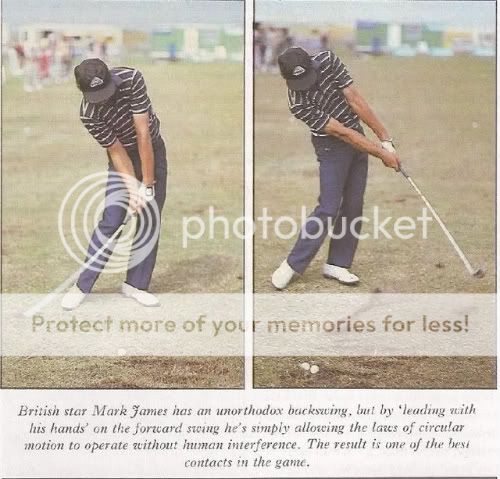
very interesting photo lynn.hands and what would be the clubhead are correct,but the bend of the shaft is the other way.it's hard to imagine the shaft looking like a c but it does.makes you wander even more how we can even hit the little ball first


Some fine points that I've learned to encourage and maintain Clubhead Lag through the Impact Interval. CL has almost nothing to do with speed. Acceleration only needs to apply a greater force than the strength of the shaft and the weight of Clubhead inertia. And, Stiff shafts bend easily. Stiffer is better. Stiff shafts stay with you.
  1. Don't create more Lag than you're prepared to Sustain (need for the length of shot)
  2. The Right Forearm must be Driven through Release and Impact
  3. The Right Forearm Flying Wedge must remain Intact. The Right Forearm Flying Wedge Alignment is what brings Clubhead Lag into Impact. Without the Alignment, no amount of Thrust will help. Clubhead Lag is "Keyed into" the Right Arm Flying Wedge Alignment at "Startdown".
  4. The Right Elbow must Straighten as the RFFW approaches the Angle of Approach for Impact. It's easy to lose Clubhead Lag when the Hands Slow. If you can't maintain Hand Acceleration, then use a smaller Pulley. That's what it's there for.
  5. The #3 Pressure Point is indispensable from start to finish. "Trace and Drag".

If you can learn to sustain Tip Bend on a fishing pole, then you can learn to sustain Clubhead Lag with a Golf Club.
If you can learn to sustain Tip Bend on a fishing pole, then you can learn to sustain Clubhead Lag with a Golf Club.[/quote]

Correct you are D. Unfortunately I am such a dummy it took me about 2 years to figure it out. And that was after about 50 years of wandering in the desert not knowing where to look for the horizon.
But now my addiction is compression. Once you find it and feel it, there is nothing like it. Those photos you posted not only look good, they feel good.
Thanks for all the illustrations and concepts you post. They are most helpful.
Originally Posted by Daryl


Some fine points that I've learned to encourage and maintain Clubhead Lag through the Impact Interval. CL has almost nothing to do with speed. Acceleration only needs to apply a greater force than the strength of the shaft and the weight of Clubhead inertia. And, Stiff shafts bend easily. Stiffer is better. Stiff shafts stay with you.
  1. Don't create more Lag than you're prepared to Sustain (need for the length of shot)
  2. The Right Forearm must be Driven through Release and Impact
  3. The Right Forearm Flying Wedge must remain Intact. The Right Forearm Flying Wedge Alignment is what brings Clubhead Lag into Impact. Without the Alignment, no amount of Thrust will help. Clubhead Lag is "Keyed into" the Right Arm Flying Wedge Alignment at "Startdown".
  4. The Right Elbow must Straighten as the RFFW approaches the Angle of Approach for Impact. It's easy to lose Clubhead Lag when the Hands Slow. If you can't maintain Hand Acceleration, then use a smaller Pulley. That's what it's there for.
  5. The #3 Pressure Point is indispensable from start to finish. "Trace and Drag".

If you can learn to sustain Tip Bend on a fishing pole, then you can learn to sustain Clubhead Lag with a Golf Club.


Do you have any pics at impact with the same look of lag? Some of that "look" is deceptive because of distortion, also there is in Hogan's power golf a pic that has the clubhead in the exact opposite position of leading before impact, do you think that's accurate?